The morning of my engagement party was baptized in an unnatural, suffocating silence, and I despised it the moment my eyes fluttered open. My daughter, Lily, was merely four years old and fundamentally incapable of a quiet dawn. Ordinarily, she would awaken long before the sun, dragging her battered stuffed rabbit by its fraying ear through the corridors, composing impromptu, off-key symphonies about dinosaurs and pancakes. She treated every single sunrise as if it were a personalized celebration orchestrated solely for her amusement. But on this particular morning, trapped within the stifling walls of my parents’ sprawling home, The Hawthorne Estate, there were no pitter-patter of tiny feet, no giggles echoing off the hardwood, and no sweet, inquisitive voice demanding to know if her birthday had finally arrived.
We had been enduring a tense, week-long stay at the estate simply because my mother, Eleanor, had vehemently insisted on hosting my engagement soirée on her meticulously manicured grounds. She masked the demand as a cherished “family tradition,” despite the glaring reality that family had never felt synonymous with warmth in that house—certainly not since I had the audacity to become pregnant at eighteen, and definitively not since Lily drew her first breath. Still, I was desperate to believe the icy glaciers of our past were finally thawing. The proposal from my fiancé, Marcus, felt like a beacon of a new epoch. And because a twist of fate had aligned Lily’s fourth birthday with the exact day of the engagement festivities, I harbored a fragile, foolish hope that my little girl might finally be acknowledged as a presence worth celebrating.
I padded barefoot down the opulent hallway toward the guest room Lily occupied, a soft smile playing on my lips, fully anticipating to find her burrowed beneath a fortress of pillows or whispering secrets to her rabbit in the reading nook.
Instead, I found an abyss of stillness.
Her bed was utterly vacant. The plush, lavender blanket she adored was violently shoved to the mattress’s edge. Her stuffed companion lay discarded on the Persian rug, its fuzzy ear bent at a painful angle. But what paralyzed the breath in my lungs was the sight of her lemon-yellow birthday dress. It hung in the closet, perfectly pressed and untouched, exactly where we had suspended it the evening prior. Every tangible trace of my daughter remained anchored in that opulent room, save for the child herself.
Initially, the dread seeped in at a glacial pace. I rationalized the emptiness. I checked the en-suite bathroom, the cavernous linen closet, the shadowy alcove beneath the grand staircase, and every conceivable cranny where a four-year-old imagination might construct a hideaway. Finding nothing but dust motes dancing in the morning light, a frantic energy seized my limbs. I practically threw myself down the sweeping staircase, bursting into the chef’s kitchen.
There stood Eleanor, the matriarch, serenely mincing organic bell peppers. She was draped in flawless pearls and a starched, cornflower-blue blouse, the very picture of a woman preparing a mundane Sunday roast rather than hosting the most pivotal event of her eldest daughter’s life.
“Have you seen Lily?” I choked out, fighting the tremor threatening to shatter my voice.
My mother didn’t even grant me the courtesy of raising her eyes from the cutting board. She offered a dismissive, single-syllable negative, fluidly slicing through a pepper before casually suggesting that the child had likely wandered off into the labyrinthine gardens.
That specific verb—wandered—twisted like a rusted blade in my gut. Lily was four. She did not wander. She functioned like a tiny, vocal homing beacon, announcing her coordinates every thirty seconds. To Lily, solitude was tantamount to a tragic exile.
Panic, now fully unfurled, drove me through the property. I scoured the detached garage, the sprawling backyard, the walk-in pantry, and the subterranean laundry quarters. By the time Marcus jogged down the stairs, his dress shirt only half-buttoned, I was ripping open low-lying mahogany cabinets with the deranged hope that my child had miraculously folded her small frame into the cookware. The moment the words “I can’t find her” spilled from my lips, the morning drowsiness vanished from Marcus’s eyes. His posture went rigid, assuming the hyper-vigilant stance of a man who intrinsically understood that a nightmare had just breached reality.
It was then that my sister, Vanessa, sauntered into the adjacent formal dining room, cradling a steaming mug of artisanal coffee. Trailing behind her like a shadow was her own child, my niece Emma, resplendent in a sequined, rose-gold ballgown and a rhinestone tiara. I blinked, my mind violently rejecting the visual data it was receiving. The mahogany dining room was engulfed in a sea of metallic balloons and cascading streamers. A massive, glittering banner hung triumphantly across the bay windows: Happy Birthday, Emma.
For an agonizing, suspended heartbeat, the universe fractured. Emma’s birthday wasn’t for another three weeks. Today was the tenth of July. Today was Lily’s day.
What kind of twisted psychological warfare is this? I thought, my heart hammering a frantic rhythm against my ribs.
I demanded to know what the grotesque display meant. Vanessa merely offered a beatific, chillingly vacant smile, as if the sky were green and the grass were blue and everything was perfectly in order. Eleanor wiped her hands on an immaculate towel and smoothly lied, claiming the stress of the event had simply caused her to confuse the dates. The alibi was laughably flimsy; we had agonizingly coordinated this dual-celebration for six grueling months. Vanessa took a languid sip of her coffee and murmured, with lethal sweetness, that some children were simply more naturally suited for the spotlight than others.
Marcus stepped protectively to my flank, his voice a low, dangerous rumble as he demanded Lily’s whereabouts. My father, seated at the head of the table, merely rustled his Wall Street Journal with a sigh of profound irritation, entirely unbothered by a missing grandchild.
My bloodline had never harbored affection for Lily in the way they worshipped Emma. They had branded my teenage pregnancy a catastrophic blunder, constantly insinuating that my daughter was an anchor dragging down my potential, speaking of her very existence as a grim penalty rather than a miracle. I had absorbed their venomous microaggressions for years, foolishly convincing myself there was a threshold of cruelty they would never cross. But standing amidst that stolen celebration, surrounded by their cold, reptilian stares, a horrifying epiphany bloomed in my chest. I had grossly underestimated their malice.
“What did you do?” I hissed, the words tasting like copper in my mouth.
Eleanor rolled her eyes, admonishing my “theatrics.” Then, Vanessa emitted a soft, tinkling laugh. She gestured lazily toward the frosted window overlooking the service alley.
“Maybe,” Vanessa whispered, “you should check the waste. Where discarded things belong.”
The silence that followed was absolute. My father chuckled—a dry, rasping sound. My mother returned her knife to the vegetables. The handful of aunts and uncles loitering in the periphery didn’t gasp in horror; they watched with the morbid fascination of spectators at a colosseum.
Behind the estate’s commercial catering kitchen sat two massive, industrial steel dumpsters, baking in the rising July heat. I bolted through the patio doors before my brain had fully processed the implication of my sister’s words. The gravel tore at my bare feet, but I felt nothing. Marcus was a blur of motion right beside me as we hit the alley. I scrambled up the filthy, rusted flank of the first dumpster, tearing wildly at slick, black garbage bags and sodden cardboard, screaming my daughter’s name into a foul vortex of rotting food and swarming flies.
The first bin yielded nothing.
The second did.
Through the suffocating stench, I spotted it. A tiny, fragile wrist protruding from beneath a mound of discarded paper plates. Encircling that pale wrist was a braided silver bracelet—the very trinket I had fastened there just twelve hours prior.
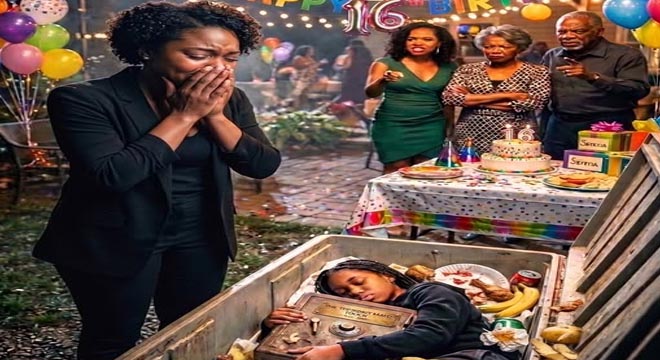
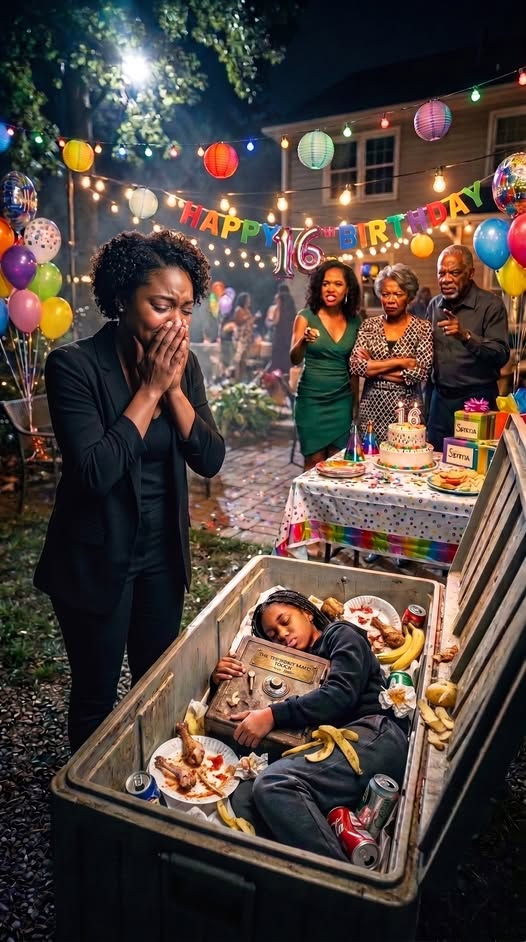
A primal, guttural sound ripped from my throat. I threw myself into the refuse, oblivious to the jagged edges and the slime, digging with the frantic, bleeding hands of a wild animal. I tossed aside heavy bags of kitchen waste, whispering prayers and curses in the same breath. And there she was. My beautiful Lily. She was curled into a tight, defensive ball, still wearing her pink polka-dot pajamas, now stained with grease and coffee grounds. She was terrifyingly motionless, one small slipper missing, the delicate skin of her lips tinged a ghastly, hypoxic blue.
My hands trembled so violently I could scarcely locate the juncture of her jaw to check for a pulse. Time stopped. The world narrowed to the pad of my index finger against her cold skin.
Then, I felt it. A flutter. A faint, irregular thrum of life.
Marcus vaulted into the filth beside me, his strong arms gently extracting her limp body from the rot. As he lifted her, a phantom memory struck me with the force of a physical blow: sitting in the sterile maternity ward four years ago, cradling Lily, while Eleanor stood in the doorway warning me that motherhood would alter the fabric of my existence.
She had been profoundly correct. It had changed everything. Because in that dumpster, surrounded by decay, I realized exactly the kind of monster I was willing to become to annihilate anyone who dared touch a hair on my child’s head.
We sprinted back toward the estate, Marcus cradling Lily against his chest. My family had migrated to the veranda, watching our frantic approach with an eerie, detached curiosity.
“You knew!” I screamed, the sound tearing my vocal cords. “You knew she was out there in the cold!”
My father finally lowered his newspaper, adopting a tone of strained patience. He casually mentioned that they had administered a small dose of pediatric Benadryl because she had been throwing a tantrum about her birthday attire, insisting the drowsy child must have simply wandered out the service doors.
Marcus didn’t break his stride. “She’s practically comatose,” he snarled, kicking the glass patio door open. “She didn’t walk out here on her own two feet.”
The wail of approaching sirens shattered the suburban tranquility. The paramedics swarmed the foyer, instantly commandeering the space, demanding a list of ingested medications. I pointed a trembling, bloodied finger directly at my mother’s face.
“They drugged her,” I stated, my voice eerily calm despite the chaos.
Eleanor scoffed, a nervous flutter in her throat, attempting to paint it as a tragic miscalculation. But Marcus locked eyes with her, his gaze as cold as absolute zero, and promised her it was no misunderstanding. As they strapped the oxygen mask over Lily’s tiny, blue lips and wheeled her toward the gaping maw of the ambulance, two black-and-white police cruisers screeched to a halt on the pristine cobblestone driveway.
For the very first time that morning, the aristocratic mask slipped from Eleanor’s face. The matriarch finally looked terrified. But she wasn’t afraid for the little girl fighting for her life in the back of the ambulance. She was afraid for herself. And as the paramedic pulled the ambulance doors shut, Marcus leaned close to me, his eyes dark with an unspoken promise that this was far from over.
The journey to St. Jude’s Pediatric Wing operated in a surreal, time-dilated vacuum. The back of the ambulance smelled sharply of antiseptic and adrenaline. Lily lay immobilized on the stretcher, her small chest rising and falling in terrifyingly shallow increments beneath a thicket of wires and sensors. The heart monitor beeped with a frantic, erratic tempo that matched my own pulse. I sat immobilized on the steel bench, gripping her icy, lifeless fingers in both of my hands, silently willing my own vitality into her veins. Marcus remained an immovable pillar at my shoulder, a silent guardian in the tempest.
Upon arrival, the trauma team descended like a synchronized flock. They bombarded us with rapid-fire questions: medical history, known allergens, environmental exposure times, and inquiries about potential toxic ingestion. I recited the answers with a hollow, robotic detachment, while Marcus managed the labyrinth of admission forms. My consciousness was ensnared in a single, looping nightmare—the visual of my radiant daughter discarded like yesterday’s trash on the dawn of her fourth year of life.
Nearly ninety excruciating minutes bled by before the attending physician, Dr. Aris, pushed through the swinging double doors. His expression was a carefully constructed mask of professional gravity.
Lily had stabilized.
He explained that while the dosage of diphenhydramine hadn’t breached the lethal threshold, it was catastrophically high for a child of her weight class. When compounded by the plunge in nocturnal temperatures and the sheer shock of exposure among the damp refuse, her small cardiovascular system had been pushed to the absolute brink of failure. Dr. Aris clicked his pen shut, his gaze piercing through me. He lowered his voice, asking gently if there was any possibility the medication had been administered with malicious intent.
I turned my head slowly, locking eyes with Marcus.
The silence stretched, thick and suffocating. Because the moment I permitted those words to cross the boundary of my lips, the Rubicon would be crossed. There would be no retreat.
My own blood did this.
The concept was a violation of the laws of nature. Yet, it was the undeniable, rotting truth.
While the medical staff continued their frantic work to flush the toxins from Lily’s system, a pair of uniformed officers escorted Marcus and me into a sterile, beige family consultation room. They initiated the standard protocol, asking about timelines, residents of the property, and the chain of custody regarding the medication. I laid it all bare. The sickening pivot of the birthday decorations. Vanessa’s sadistic quip about the waste bins. The years of thinly veiled contempt and the persistent narrative that my child was an unwanted parasite on the family tree.
The older officer, a man with tired eyes and a greying mustache, paused his furious scribbling.
“A mistake?” he echoed, his brow furrowing in distaste.
I nodded, swallowing the lump of jagged glass in my throat. “That is the precise terminology they’ve used to describe my daughter since the day she was born.”
Then, Marcus’s memory snapped a puzzle piece into place. He leaned forward, resting his elbows on his knees. “Last night,” he began, his voice tight. “Lily was upset. She wanted to sleep in her birthday dress so she’d be ready for breakfast. Vanessa scolded her. She told Lily that birthdays were reserved for ‘special girls,’ not girls who ruined other people’s plans.”
At the time, in the chaotic hum of the evening, it had merely registered as another drop in a bucket of routine cruelty. But here, bathed in the harsh fluorescent light of a police interview room, it metamorphosed into something far darker. It was premeditation.
Around noon, a lead detective, a sharp-featured woman named Miller, entered the room carrying a translucent, heavy-duty evidence bag.
Suspended inside the plastic was Lily’s stuffed rabbit.
One entire half of its faux fur was caked in dried, foul-smelling mud. Detective Miller placed it softly on the table, explaining that crime scene technicians had recovered the toy wedged behind the rear wheel of the second dumpster.
But it was what they found pinned beneath the rabbit that made the blood roar in my ears.
Miller produced a second bag. Inside rested a crumpled, folded piece of pink cardstock.
Emma’s birthday crown.
The identical, sequined material that currently adorned the dining room of the estate.
Bile surged in my throat. Someone had physically dragged my unconscious child into the freezing night, dumped her into a metal coffin of filth, and callously dropped that crown on her toys as a twisted parting signature. They had methodically constructed a shrine to Emma while my daughter slowly asphyxiated in the garbage.
Suddenly, my phone shattered the heavy silence.
The caller ID flashed: Mom.
I stared at it. I pressed decline.
It rang again. And again. Relentless.
Finally, with hands slick with cold sweat, I swiped to answer, activating the speakerphone and placing the device in the center of the table. The detectives leaned in.
“Madison, sweetheart,” Eleanor’s voice crackled through the speaker, laced with a synthetic, tremulous panic. “This situation is spiraling wildly out of control.”
“Out of control?” I repeated, my voice devoid of any inflection.
“We… we had no idea she would stay out there in those bins.”
The oxygen vanished from the consultation room.
Marcus’s head snapped up. Detective Miller’s pen froze on her notepad.
We.
“You knew,” I whispered, a terrifying calm settling over my soul.
“No, Madison, you have to listen to reason—”
“You knew she was in that dumpster.”
Eleanor let out an exasperated sigh, the mask of the put-upon mother sliding back into place. “It was only ever supposed to be a lesson, darling.”
A lesson.
A violent tremor began in my core and violently shook its way out to my fingertips. “What conceivable lesson, Mother?”
“That she cannot constantly hijack the narrative. That she isn’t the center of the universe just because she was an accident.”
I reached out and ended the call.
The line went dead. Detective Miller didn’t need to ask for permission. She simply requested that I formally dictate the contents of that admission into the official record.
I did. Syllable by sickening syllable. I repeated it twice to ensure there was no ambiguity. Because in the span of a three-minute phone call, the illusion of familial bonds had been immolated. We were no longer dealing with estranged relatives. We were dealing with a criminal conspiracy.
Dusk was painting the sky in bruises of purple and black when Lily finally stirred.
Her eyelids fluttered, parting slowly to reveal unfocused, cloudy irises that roamed the stark hospital ceiling before finally anchoring on my face. She reached out with a weak, trembling hand, and I collapsed over the bed rail, burying my face in her chest before she could utter a single word.
“Mommy?” her voice was gravelly, barely a wisp of sound.
“I’m right here, my brave girl. I’m right here.”
Her lower lip quivered, a tear escaping the corner of her eye and tracking through the dirt still smudged on her cheek.
“Grandma said I ruined Emma’s big party,” she whispered.
The rotation of the earth seemed to grind to a halt.
Lily swallowed hard, her tiny brow furrowed in confusion. “She said the cake and the balloons were for wanted girls.”
I squeezed my eyes shut, a silent sob wracking my frame. Behind me, Marcus turned his back to the room, driving his fist into the wall in a mute display of helpless rage.
My daughter remembered. The drugs hadn’t erased the terror. She remembered every cruel syllable.
And somewhere across town, sipping their imported wine in their pristine mansion, my blood relatives operated under the delusion that money and influence could bleach this stain away. They believed they could sweep a discarded child under the rug. They had absolutely no comprehension that the real nightmare—my retribution—was only just beginning, and they were wholly unprepared for the monster they had awoken.
The following morning, law enforcement did not return with questions; they returned with a battering ram of legal authority.
By dawn, warrants had been executed across multiple properties. The police had transformed the Hawthorne Estate into a sprawling crime scene. Technicians meticulously photographed the rusted dumpsters, dusted the perimeter for prints, confiscated every pharmaceutical bottle from Eleanor’s pristine medicine cabinets, and, crucially, seized the digital hard drives governing the security network of Hawthorne Elegance Catering, the crown jewel of my family’s societal influence. My mother, in her infinite arrogance, had continued to pedal the narrative of a “tragic misunderstanding” to anyone who would listen. Vanessa, playing the victim, wept to the officers, claiming no one would ever intentionally harm a child.
But digital memory does not possess the capacity to lie.
Detective Miller returned to St. Jude’s just after lunch, spreading a series of high-resolution stills across the consultation table like a winning hand of tarot cards.
The timestamped footage painted a damning, irrefutable timeline. At 9:35 PM, the cameras captured Lily sitting solitary at the granite kitchen island. She was clad in her pink pajamas, clutching her rabbit, her small legs swinging anxiously. Seven minutes later, at 9:42 PM, Vanessa materialized in the frame. The footage explicitly showed my sister handing Lily a brightly colored plastic cup, whispering something that made the child shrink in on herself, and then firmly taking her by the elbow, leading her out the rear service exit toward the gravel alleyway.
Lily never reappeared on the feed.
The timestamp perfectly synchronized with the exact window of time Eleanor was directing the catering staff to erect Emma’s fraudulent birthday banner in the dining room.
Then, Miller delivered the coup de grâce.
A sweep of the catering prep stations had unearthed a discarded sleeve of disposable plastic cups. Deep within one of the receptacles, forensic analysts discovered residual traces of liquid cherry juice heavily laced with crushed diphenhydramine. They lifted two sets of distinct fingerprints from that specific cup.
One set belonged to Lily’s tiny, frantic grip.
The other set belonged, unequivocally, to Vanessa.
The floor seemed to drop out from beneath me. Marcus gripped my shoulder with a bruising intensity, his jaw locked in a silent roar of vindication. The walls they had built out of money, status, and lies were crumbling into dust. There was no more maneuvering. No more gaslighting. The trap had snapped shut.
That afternoon, the final nail was driven into the coffin. Detectives conducted a formal forensic interview with Lily, guided by a specialized child psychologist. Marcus and I stood in the shadowed observation booth, staring through the two-way glass as our bruised, resilient girl sat in an oversized chair, her small arms wrapped fiercely around a newly scrubbed rabbit.
The psychologist, a gentle woman with a soft cadence, asked Lily to describe the events of her birthday eve.
Lily stared at her lap, her voice a fragile whisper that echoed through the monitors.
“Grandma told me I was in the way. She said Emma needed a very special day because she was good.”
The room grew dense. Lily took a shaky breath.
“Then Auntie Vanessa gave me sleepy juice.”
Nobody in the observation room dared to breathe.
Lily continued, her eyes welling with unshed tears. “She took me to the smelly boxes outside. She said I had to hide in the dark because my face makes people sad.”
The psychologist paused her recording device, her professional composure fracturing for a fraction of a second. Next to me, Marcus turned on his heel and walked out of the observation booth entirely. His knees had buckled; he couldn’t bear to stand and listen to the autopsy of his daughter’s innocence.
Forty-eight hours later, the district attorney filed the paperwork.
The charges were a spectacular cascade of ruin: Felony child endangerment. Criminal neglect. Unlawful administration of a controlled substance. And, most devastatingly, conspiracy.
The fallout was apocalyptic. The Hawthorne name, once a pillar of local high society, became radioactive overnight. The local news cycle feasted on the scandal. Clients canceled their contracts with Hawthorne Elegance Catering en masse. Relatives who had chuckled over their coffee cups during the search suddenly suffered mass amnesia, refusing to answer my mother’s frantic phone calls. The impenetrable facade of the perfect aristocratic family imploded, leaving nothing but ash and indictments.
Eleanor attempted one final, desperate maneuver before her arraignment. She called me from a holding cell.
The instant I answered, the haughty matriarch was gone, replaced by a sobbing, broken woman. “Madison, I am begging you. Please. You have to tell them to stop. We are family.”
I sat in the sterile hospital chair, watching Lily methodically color a picture of a yellow sun in her sketchbook.
“No, Eleanor,” I answered, my voice cold and hard as diamond. “Family protects their own. Monsters throw children away.”
I disconnected the line for the final time.
A week later, we carried Lily across the threshold of our own home.
Marcus had transformed our modest living room into a sanctuary of joy. A sea of sunshine-yellow balloons blanketed the ceiling, and a massive, hand-painted banner dominated the wall. It read:
Happy Birthday, Lily.
Just Lily.
No strings attached. No conditions of worthiness. No shadows of a favored cousin. Just pure, unadulterated celebration for the child who survived the dark.
When she shuffled through the doorway and saw the spectacle, she froze, dropping her rabbit. Her eyes went wide, reflecting the yellow light.
“For me?” she whispered, as if expecting it to be a cruel trick.
I sank to my knees, wrapping my arms around her solid, warm little body. “Only for you, my sweet girl. Today, tomorrow, and every day after.”
She buried her face in the crook of my neck, her tiny hands fisted in my shirt, and she wept. And so did I.
The wheels of justice ground slowly over the ensuing months. The Hawthorne catering empire dissolved into bankruptcy, auctioned off to pay exorbitant legal fees. Vanessa accepted a plea deal, resulting in heavy probation and severely restricted, state-supervised visitation with Emma. At the final sentencing hearing, Eleanor sobbed uncontrollably as the gavel fell. My father sat rigid, staring straight ahead, refusing to meet my gaze even once.
Walking out of the courthouse, I didn’t feel the euphoric rush of victory. You don’t win a war like this; you simply survive the casualties. It was merely consequence, finally delivered.
That night, long after the house had settled into a peaceful quiet, I cracked open Lily’s bedroom door. She was fast asleep, the rhythmic rise and fall of her chest the most beautiful sight in the world. Tucked securely under her chin was the battered stuffed rabbit, forever scarred by the dumpster, yet stubbornly whole.
I stood in the doorway for a long time, watching the moonlight pool on her blankets.
The little girl they had branded a mistake.
The child they had conspired to replace.
The daughter they had literally thrown away in the dark.
She was still here. She was still breathing. She was fiercely, irrevocably mine.
And as long as I drew breath on this earth, nobody would ever touch her again.
If you want more stories like this, or if you’d like to share your thoughts about what you would have done in my situation, I’d love to hear from you. Your perspective helps these stories reach more people, so don’t be shy about commenting or sharing.