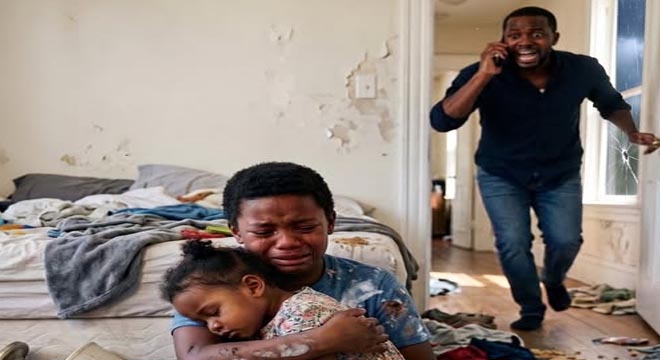
Chapter 1: The Ringing in the Void
The suffocating hum of the boardroom was suddenly shattered by the vibration of my phone against the mahogany table. I was halfway through a quarterly financial projection in my downtown Nashville office, desperately trying to keep the attention of five exhausted executives. I almost let it ring out. It was an unknown number, and my brain, wired for the relentless efficiency of corporate life, instantly categorized it as a vendor or a spam call. But some instinct—a cold, primitive tug deep in my gut—forced my hand downward. I would remember that ordinary, fleeting hesitation for the rest of my life. It was the absolute final second of my old existence.
I answered with a distracted, tight-lipped, “Hello?”
For a heartbeat, there was nothing but static. I heard the faint, papery rustle of movement, a sharp intake of breath, and then a tiny voice, stretched thin with a terrifying cocktail of fear and exhaustion, bled through the speaker.
“Dad?”
I was out of my leather chair before my conscious mind fully processed the sound. “Micah? Why are you calling me from a stranger’s phone? What’s going on?”
My six-year-old son sniffed hard. It was the awful, shuddering sound of a child trying to manufacture bravery after being brave for far too long. “Dad, Elsie won’t wake up right. She keeps sleeping and she feels really hot. Mom isn’t here. We don’t have anything left to eat.”
The conference room, the glowing spreadsheets on the projector, the perplexed faces of my colleagues waiting for me to finish my sentence—all of it disintegrated. The world tunneled down to the dimensions of my phone screen. My chair scraped backward with such violent force that it slammed into the credenza, startling the CFO, but I offered no explanation. I didn’t apologize. I didn’t even grab my suit jacket or my briefcase. I snatched my car keys and bolted for the glass doors, my thumbs flying across my screen to dial my ex-wife’s number as I sprinted toward the elevator bank.
Straight to voicemail.
I jammed my finger against the screen, redialing.
Voicemail.
Again.
Nothing. Just the cheerful, recorded voice of Delaney, telling me to leave a message.
By the time I hit the concrete floor of the subterranean parking garage, my pulse was hammering a frantic, deafening rhythm against my eardrums. My hands trembled so violently I dropped my keys twice before unlocking the sedan. Delaney had told me casually, earlier that Tuesday, that she was taking the kids up to a friend’s lake cabin where cell service was spotty. We were navigating the treacherous waters of our carefully negotiated custody agreement, and because our co-parenting dynamic had been icy but functional for the past eight months, I hadn’t questioned her.
Now, tearing out of the garage and swerving into the brutal midday downtown traffic, all I could hear was Micah’s fragile voice echoing in the confines of the car. We don’t have anything left to eat.
I mashed the accelerator, weaving dangerously between a delivery truck and a cab, my jaw clamped so tight my teeth ached. “Come on,” I hissed at the windshield, my knuckles bone-white against the leather steering wheel. “Come on, Delaney. Pick up the goddamn phone.”
The call dropped. The silence in the car was deafening. I was ten minutes away from her rental house in East Nashville, but it felt like a thousand miles. As I swerved off the main avenue, my mind spun through catastrophic scenarios, each darker than the last. I hit the brakes, throwing the car into park halfway on the curb outside her quaint, suburban home.
Something was wrong. The front porch lacked the usual chaotic sprawl of plastic trucks and chalk. There was no music thumping from the living room windows. The house sat dead and silent under the glaring afternoon sun.
I vaulted up the wooden steps and slammed both fists against the heavy oak door. “Micah! It’s Dad! Open the door!”
No response. Just the hollow echo of my own voice. I grabbed the brass doorknob, twisted, and felt my stomach drop into a bottomless abyss as the heavy door creaked inward, completely unlocked.
Chapter 2: Dust, Echoes, and Fever
The air inside the house hit me first—stale, suffocating, and reeking of neglected trash and sour milk. The absolute absence of sound was paralyzing. I stepped over the threshold, my dress shoes crunching on a scattering of crushed cereal embedded in the entryway rug.
“Micah?” I called out, my voice cracking.
Then I saw him.
He was huddled in the corner of the living room, wedged between the sofa and the wall, clutching a faded throw pillow against his small chest. His blonde hair was matted to the side of his skull, his cheeks smeared with dirt and dried tears. But what shattered my heart wasn’t the mess; it was his posture. He carried that unmistakable, chilling stillness that children adopt when they have bypassed panic and settled into a hollow, traumatized waiting.
He lifted his chin, his blue eyes huge and vacant. “I thought maybe you weren’t coming.”
I crossed the room in two massive strides, dropping to my knees hard enough to bruise them on the hardwood. I grabbed his narrow shoulders, pulling him against my chest. He felt painfully light. “I’m here, buddy. I’m right here. Where’s your sister?”
Micah didn’t speak. He just raised a trembling finger and pointed toward the far end of the sectional couch.
A lump of blankets rested there. I scrambled over, tearing the heavy quilt back. Elsie lay curled in a tight ball. Her face was a terrifying juxtaposition—chalky white but flushed with angry, mottled red patches across her cheeks. Her lips were cracked and bleeding, and her chest rose and fell in shallow, rapid hitches.
I pressed my palm against her forehead and ripped it back instantly. The heat radiating from her tiny body was agonizing. I scooped her up, and her head lolled back against my forearm with zero resistance. She was completely limp, a ragdoll in a three-year-old’s clothes.
“We’re leaving right now,” I commanded, forcing an unnatural, terrifyingly calm cadence into my voice for Micah’s sake. “Shoes on, buddy. No questions. You stay glued to me.”
Micah scrambled to his feet, swaying slightly as he grabbed a pair of mismatched sneakers. “Is she sleeping?” he whispered.
Acid churned in my stomach. “She’s just sick, Micah. We’re going to get her to the doctors.”
As I turned toward the hallway, I caught sight of the kitchen. It was a tableau of neglect that would burn itself into my retinas forever. An empty, crushed box of generic Cheerios lay sideways on the counter. The sink was a mountain of crusted plates. I kicked the refrigerator door open with my foot—one half-empty bottle of generic ketchup, a moldy lemon, and absolutely nothing else. No milk. No fruit. Nothing a desperate six-year-old could have scavenged to keep himself and his dying sister alive. On the floor beside the sink sat a plastic sippy cup, a dark ring of dried, sticky juice coating the bottom.
A red-hot spike of fury pierced my brain, but I shoved it down. Anger wouldn’t save Elsie. I carried my lifeless daughter out the front door, ushered Micah into the backseat of my sweltering car, and peeled away from the curb.
I drove toward Vanderbilt Children’s Hospital with my hazard lights flashing, laying on the horn through every red light. I kept my left hand tight on the steering wheel, my right hand reaching blindly back into the rear seat, my fingers brushing Micah’s knee, Elsie’s ankle, as if my physical touch alone could tether them to the land of the living.
From the shadows of the backseat, Micah’s voice drifted forward, so frail I almost couldn’t hear it over the roar of the engine. “Is Mom mad?”
I kept my eyes locked on the bumper of the car in front of me, swerving into the emergency lane. “No. Your mom isn’t mad at you. Right now, I just need you to listen to me, okay? I’ve got you both. Nobody is mad.”
He was quiet for a long, agonizing minute.
Then he whispered, “I tried to make Elsie crackers on the first day, but she wouldn’t chew them.”
My throat constricted so violently I couldn’t breathe. “You did exactly the right thing by calling me, Micah. You’re my hero.”
The illuminated red emergency sign of the hospital finally breached the horizon, a beacon in the nightmare. I slammed the car into park at the ambulance bay, unbuckled Micah, and sprinted through the sliding glass doors with Elsie in my arms.
“Help me!” I roared into the sterile, bright lobby. “My daughter isn’t waking up!”
A triage nurse took one look at Elsie’s mottled skin and hit a button on the wall. Within three seconds, a gurney materialized, and my little girl was ripped from my arms, disappearing behind a set of double doors, leaving me standing in the blinding neon light with a traumatized little boy clutching my pant leg, waiting for the sky to fall.
Chapter 3: The Cold Neon Waiting Room
The emergency room doors clamped shut, sealing Elsie away from me.
“How old is she?” a frantic intake nurse demanded, her fingers hovering over a tablet.
“Three,” I stammered, my chest heaving. “High fever. Unresponsive. She hasn’t eaten in days. They… they were left alone.”
The nurse’s professional facade slipped for a fraction of a second, her jaw tightening. “We have her, sir. We’re getting a line in her now.”
Another nurse, an older woman with kind, crinkled eyes, crouched down beside Micah. “Hey there, brave guy. Do you want to come sit with your dad while we help your little sister feel better?”
Micah didn’t speak. He just buried his face into my thigh, his tiny fingers digging into the fabric of my trousers like talons. I sank to my knees right there in the middle of the linoleum floor, pulling him into a fierce embrace. “I’m right here,” I murmured into his dirty hair. “I am not moving.”
“Is she gonna die?” Micah sobbed, the question tearing out of him in a wet, jagged gasp.
I had never made a promise with less evidence and more desperate necessity. “No. Absolutely not. She is going to be perfectly fine.”
For the next forty minutes, time ceased to function logically. I was pulled into a small, sterile side office and subjected to an onslaught of interrogations. I gave the registration desk every insurance detail I could remember. Then, the real nightmare began. A hospital social worker—a stern, impeccably composed woman with silver wire-rimmed glasses and a thick yellow notepad—stepped into the room.
“Mr. Mercer,” she began, her voice clinically detached. “We need to establish the whereabouts of the children’s mother. Do you know where she is?”
“No,” I answered, the syllable dropping like a lead weight. “I haven’t spoken to her since Friday afternoon.”
She scribbled something down, the scratch of her pen grating against my nerves. “Are you prepared to take temporary, unilateral responsibility while the state documents this incident?”
“I am prepared to do whatever it takes to ensure my kids never spend another second in that house,” I snapped, the adrenaline finally morphing into a cold, hardened resolve.
Before she could press further, a doctor in blue scrubs appeared in the doorway. He looked exhausted, but the grim set of his mouth had softened. “Mr. Mercer?”
I was on my feet instantly.
“She’s stable,” the doctor said, letting out a long breath. “She was dangerously severely dehydrated, which triggered a cascading stomach infection. Her body simply had no fuel left to fight it off. We’ve pushed broad-spectrum antibiotics and two bags of fluids. She’s sleeping naturally now. But I have to be frank with you… if you had found them even twelve hours later, we would be having a very different conversation.”
I closed my eyes, bracing myself against the doorframe as a wave of dizziness washed over me. I let out a breath that felt like it had been trapped in my lungs for a century. Micah tugged at my sleeve. “Can I see her now?”
The doctor smiled gently at him. “In just a few minutes, buddy. She’s getting a special bed right now.”
I sat back down, pulling Micah onto my lap. We were safe. The worst was over. Or so I foolishly believed.
Two hours later, after I had watched Micah devour a plastic container of applesauce, two packs of saltines, and half a turkey sandwich with the feral, stunned concentration of a survivor, a different nurse approached us. She wasn’t carrying medical charts. She carried a locked expression of profound discomfort.
“Mr. Mercer? Could you step out into the hallway for a moment?”
I asked the social worker to sit with Micah and stepped out under the buzzing fluorescent lights.
“We ran a system-wide check to notify the mother, per protocol,” the nurse said softly, her eyes darting away from mine. “Your ex-wife, Delaney… she was admitted to Nashville General Hospital at two o’clock on Saturday morning.”
My brain short-circuited. “Saturday? What? Was she sick?”
“She was brought in following a severe motor vehicle collision,” the nurse replied, her voice dropping to a whisper. “She came in as a Jane Doe. Unconscious. She was pulled from the wreckage by EMS. The driver—an unidentified adult male—fled the scene before authorities arrived. She sustained a traumatic brain injury and multiple compound fractures. She’s been in a medically induced coma until early this morning.”
The hallway spun. The sterile white walls seemed to close in on me. I stared at the nurse, waiting for the punchline to this sick, twisted joke. Delaney hadn’t just forgotten them. She hadn’t just been negligent. She had locked a three-year-old and a six-year-old in a house, lied to me about taking them to a cabin, and went out drinking with a stranger.
And then she shattered her body against a concrete barrier, leaving my children to slowly starve in the dark.
“Is she awake now?” I asked, my voice devoid of any human emotion.
“She is. She’s stabilized.”
“Thank you,” I whispered. I turned my back on the nurse, pulled my phone from my pocket, and dialed my attorney. It was time to burn the old world down.
Chapter 4: The Shattered Truth
“Avery, I need you to file an emergency ex parte motion for sole physical and legal custody,” I said the millisecond my lawyer answered.
Avery Kline was a shark in a tailored suit, a woman who didn’t deal in pleasantries. “Rowan, what the hell is going on? It’s three in the afternoon.”
“Delaney abandoned the kids on Friday,” I rattled off, the words tasting like ash in my mouth. “Elsie is on an IV drip for severe dehydration at Vanderbilt. Micah is traumatized. Delaney has been at Nashville General since Saturday after wrapping a car around a pole while out with some guy who left her for dead.”
I heard the sharp intake of breath on the other end of the line. Avery didn’t waste time with sympathy. “I’m firing up my laptop right now. Send me photos of the house, Elsie’s admission paperwork, and the police report from the crash the minute you have it. The judge will sign this before dinner.”
I hung up, leaning my forehead against the cool, painted cinderblock of the hospital corridor. A torrential wave of rage threatened to pull me under. I wanted to march across town, walk into Delaney’s hospital room, and scream until my lungs bled. I wanted her to feel a fraction of the terror Micah had felt huddled in that empty living room. But the blinding anger was quickly suffocated by something heavier, something messier. Pity. Delaney hadn’t plotted to abandon them. She was a broken woman who had made a catastrophic, selfish choice, and the universe had punished her brutally for it.
But sympathy wouldn’t feed my children. Remorse wouldn’t rewind time.
I walked back into Elsie’s room. Micah was sitting in a vinyl chair that swallowed him whole, his chin resting on the metal bedrail, watching his sister’s chest rise and fall with mechanical precision. He looked like an old man trapped in a little boy’s body.
“Dad?” he croaked without taking his eyes off her. “Can I stay at your house all the time now?”
I knelt beside him, wrapping my hand around his small, fragile shoulder. “From this second forward, you never have to sleep anywhere you don’t want to. I’ve got you.”
We spent the entire night in that suffocating room. Micah finally passed out on a terrible foldout cot, tangled in a scratchy blanket. I sat rigid in a plastic chair between my two sleeping children, listening to the rhythmic beep of Elsie’s vitals and the muffled, echoing chatter of the night shift nurses changing guard. I didn’t close my eyes for a single second.
When the sun finally breached the horizon, casting a sickly yellow glow through the blinds, a pediatric trauma therapist entered the room. She was young, but her eyes held the heavy wisdom of someone who had seen too many broken families.
“Mr. Mercer,” she began, keeping her voice low. “I’ve reviewed the intake notes. We need to talk about Micah.”
I nodded, gripping my coffee cup like a lifeline. “Tell me what to do. I’ll do anything.”
“Your son absorbed a catastrophic amount of psychological burden,” she explained plainly, pulling no punches. “He kept his sister alive. He made the call. He was incredibly resourceful. But that means he has stepped out of the role of a child and into the role of a protector. He is going to carry a paralyzing fear of abandonment. Elsie will likely regress and attach to him like a second skin, because you weren’t there, and her mother wasn’t there. Only Micah was there. You have to start dismantling that dynamic immediately.”
Her words felt like physical blows. “How?”
“Predictability,” she stated. “He needs extreme routine. No surprises. Calm, unwavering presence. You answer his questions honestly, without giving him adult burdens. And above all, you do not make a single promise to him that you cannot keep with absolute certainty.”
That last sentence gutted me. Until yesterday, I thought being a good father just meant loving them fiercely. Now, staring at their pale faces, I understood that love was useless if it wasn’t structural. Love had to be the foundation of a house that wouldn’t blow down when the wind changed.
At noon, Elsie finally fluttered her eyes open. She looked around the room, bewildered, the color fully restored to her cheeks.
Micah practically launched himself out of his cot, bursting into heavy, racking sobs for the first time since I found him. He scrambled onto the edge of her hospital bed and buried his face in her neck. “I missed you,” he wailed.
Elsie blinked slowly, reaching up with a weak hand to pat his messy hair. “I was just sleepy, Mikey.”
I wrapped my arms around both of them, burying my face in the tangle of their warmth. “You’re both safe now,” I whispered.
But I knew the real battle hadn’t even begun. I kissed their foreheads, told Micah I would be back in exactly ninety minutes, and asked the nurses to keep a close eye on them.
I had an appointment across town.
Chapter 5: The Confrontation
The drive to Nashville General was a blur of gray concrete and white-hot adrenaline. I parked in the visitor’s garage, bypassed the front desk, and navigated the labyrinthine corridors until I found the surgical recovery wing.
Room 412.
I stood outside the door for a full minute, my hand resting on the brushed steel handle, listening to the rhythmic hiss of a ventilator down the hall. I took a breath, pushed the door open, and stepped inside.
Delaney was propped up against a bank of pillows. The sight of her stopped me dead in my tracks. Her left arm was encased in a thick plaster cast. The right side of her face was an ugly canvas of purple and black bruising, her cheekbone swollen to the size of a golf ball. Her usually perfect hair was tied back in a greasy, careless knot. She looked incredibly small, fragile, and utterly defeated.
She turned her head slowly. When she saw me, all the remaining color drained from her unbroken skin. She didn’t say a word. She just squeezed her eyes shut.
I stepped up to the foot of the bed, gripping the plastic railing so hard the plastic creaked.
“The kids are alive,” I said. My voice was a frozen lake—flat, cold, and deadly. It surprised even me.
Delaney let out a ragged, choking sob, turning her face into her shoulder. “I know. The police came. They told me.”
“What the hell happened, Delaney?”
Her answer came agonizingly slowly, as if she had to drag each syllable up through a thick layer of shame and narcotics. She hadn’t planned it. She had been drowning under the weight of solo custody weeks, the endless bills, the suffocating loneliness. She met a guy at a coffee shop. He invited her out for a drink on Friday night. She had intended to lock the doors, go for two hours while the kids slept, and be back before midnight. Just to feel like a human being instead of a machine.
But two hours turned into four. One drink turned into six. They got into his truck. They argued about his driving. He missed a curve on a backroad at sixty miles an hour. After the glass shattered, there was only darkness until she woke up handcuffed to a hospital bed, facing criminal neglect charges.
“You left a six-year-old and a three-year-old in a house with a locked front door and half a bottle of ketchup,” I stated, refusing to raise my voice. The lack of theatrics made the words slice deeper. “Micah tried to feed her stale crackers. He thought his little sister was going to die on the couch.”
Delaney covered her mouth with her good hand, her body convulsing with silent, violent weeping.
I let the silence hang in the sterile air, heavy and suffocating, until she was forced to look at me again.
“I signed the papers an hour ago,” I said calmly. “I am filing for full, unilateral, temporary custody. The kids will not be returning to your house.”
She stared at me, her eyes bloodshot and wide with sheer panic. “Are you… are you taking them away from me forever, Rowan?”
I shook my head once. “I am protecting them from you. What happens in the future depends entirely on what you do when you walk out of this hospital.”
To her absolute credit, she didn’t fight back. She didn’t hurl accusations about my workaholic past. She didn’t reach for easy excuses or point fingers. She just let her head fall back against the pillows. After a long, torturous silence, she asked the only question that mattered.
“How are they?”
“Elsie is recovering,” I replied. “Micah saved her life. But his childhood is gone.”
That sentence broke whatever structural integrity Delaney had left. She wept openly, and watching her, I realized a painful truth: remorse can be absolute, genuine, and devastating, and still be entirely insufficient to undo the damage done.
Before I turned to leave, she forced out a whisper. “I requested a psychiatric evaluation this morning. I’m starting intensive therapy.”
I paused in the doorway, the harsh hallway light casting a long shadow into the room. “Good. Don’t stop.”
Chapter 6: The Weight of the Roof
Bringing them home was supposed to be the victory lap. It was anything but.
The first six weeks in my house were a grinding, relentless lesson in humility. The trauma had rewired my children. Micah refused to sleep in his own bed. He would wake up screaming at 2:00 AM, thrashing in his sheets, yelling for both me and his mother simultaneously. Elsie became his shadow. She wouldn’t let him go to the bathroom alone; I frequently found them sitting on the floor tile together, waiting for each other in terrified silence.
I had to dismantle my entire corporate life. I took an extended leave of absence. I became a master of the mundane. I learned how to cut sandwiches into perfect triangles, how to decipher the subtle difference between a tired cry and a terrified cry. I burned grilled cheese sandwiches, ruined laundry by mixing darks and lights, and once forgot to pack Micah’s lunch, resulting in a panic attack in the school hallway that took an hour to de-escalate.
But I didn’t break. I stayed.
I sat through weekly play-therapy sessions. I read the same bedtime stories until my voice went hoarse. I built a fortress of predictability. Breakfast at 7:00 AM. Park at 4:00 PM. Lights out at 8:00 PM. Slowly, microscopically, the terror began to drain out of their eyes.
Meanwhile, Delaney fought her own war. She complied with every mandate the state threw at her. She attended outpatient rehab, secured a small, ground-floor apartment, severed all ties with the man from the crash, and submitted to weekly drug and alcohol screenings.
Eventually, the court permitted supervised visitation at a neutral county facility.
The first visit was agonizing to witness. I sat in a plastic chair in the observation room while Delaney sat on a play-mat. Micah stood ten feet away, stiff as a board, refusing to make eye contact. Elsie hid behind my legs, peering out at her mother as if she were a stranger wearing a familiar mask. Delaney didn’t push. She didn’t beg for forgiveness or try to force affection. She just opened a coloring book, picked up a crayon, and narrated what she was drawing.
She showed up. Every Tuesday. Every Thursday. She was a quiet, consistent presence.
Children are remarkably like plants; they instinctively lean toward the light, provided the light is steady. By month three, Elsie was sitting in Delaney’s lap. By month four, Micah was showing her his school projects. The ice was thawing, but the sword of Damocles still hung over our heads: the final family court hearing was approaching, and a judge would decide the permanent fate of our fractured family.
Chapter 7: The Gavel and the Grace
Late September brought a crisp chill to the Nashville air, and with it, the day of reckoning.
I sat in the polished wooden pews of the family courthouse, wearing a tailored navy suit, clutching a leather binder stuffed with therapy notes, medical clearances, and character references. Delaney sat at the opposite table. She wore a simple, modest cream blouse. She looked healthy, clear-eyed, and terrified. She knew that one wrong word today could permanently sever her rights.
The judge, a stern-faced man with a shock of white hair, peered over his glasses, shifting through the mountain of paperwork. Delaney’s attorney spoke first, aggressively highlighting her remarkable turnaround—the clean drug tests, the stable housing, the unwavering attendance at therapy.
My attorney, Avery, countered with cold, hard facts. She reminded the court of the near-fatal dehydration, the psychological scars on Micah, and the irrefutable evidence of gross negligence.
The judge sighed, rubbing his temples. He looked directly at me. “Mr. Mercer. The state recognizes your extraordinary efforts. But the law favors reunification when safe. What is your position on this mother’s request for progressive, shared custody?”
I stood up. I didn’t look at Avery. I looked across the aisle at Delaney. Her hands were shaking.
“Your Honor,” I began, my voice echoing in the cavernous room. “My children’s safety is my only priority. They went through hell. But… they also love their mother. Desperately. I have watched her put the work in over the last six months. If the psychological experts believe that a gradual, structured reintroduction to her home is safe, I will not stand in the way. I just need the pace to match exactly what Micah and Elsie can handle. No faster.”
The judge’s expression softened. He nodded slowly.
The gavel fell. The ruling was a masterclass in compromise: I retained primary physical custody, but Delaney was granted progressive, unsupervised weekend visitations, heavily monitored by their therapist, with a mandatory review in six months.
In the chaotic hallway outside the courtroom, Delaney walked up to me. Her eyes were shining with unshed tears. “Thank you,” she whispered, her voice cracking. “Thank you for not burying me when you had the chance.”
I looked past her, through the glass doors, to where my parents were sitting on a bench with Micah and Elsie. “This was never a war, Delaney. It was just a rescue mission.”
The evolution of our family didn’t happen overnight. It was a glacial, awkward dance. Supervised visits became Saturday afternoons at the park. Saturday afternoons became overnight stays at her new apartment. Her place was small, but she had built a beautiful reading nook for Elsie, and she kept a dedicated shelf of board games just for Micah. She had learned the hardest lesson of parenting: how to listen instead of talk, how to wait for trust rather than demand it.
One evening, driving home from a drop-off, Micah stared out the window and casually asked, “Dad? Can Mom come to my winter recital? I want both of you in the front row.”
I glanced at him in the rearview mirror, feeling a knot loosen in my chest that had been tight for a year. “Of course she can, buddy. We’ll sit right next to each other.”
Another night, Elsie climbed into my lap while I was paying bills. She slapped a piece of construction paper onto my keyboard. It was a crude crayon drawing of two wildly disproportionate houses, connected by a massive, arching rainbow.
“This is us,” she announced with absolute authority. “We live in two places, but we go together.”
I stared at the scribbled lines for a long time. “Yeah, sweetheart. We absolutely do.”
At our final one-year review hearing, the judge did something highly unusual. He invited the kids into chambers to speak, deeming them well-prepared by their therapist.
When asked how things were going, Micah looked the judge dead in the eye and said, “I like it now. Nobody screams, and everybody tells the truth.”
Elsie just handed the judge a drawing of four stick figures holding hands under a blazing yellow sun.
The judge smiled, signed the permanent shared custody decree, and leaned over his massive desk. “It seems to me, Mr. and Mrs. Mercer, that you two have done the hardest work a human being can do. You learned a better way forward.”
We walked out of the courthouse together into the bright, crisp autumn afternoon. Micah immediately demanded a celebratory ice cream. Elsie insisted on rainbow sprinkles. Delaney and I caught each other’s eyes over their heads.
It wasn’t a look of romance. It wasn’t a spark of our old, naive love. We weren’t getting back together. But what existed between us now was something infinitely stronger, forged in the fires of near-tragedy. It was an unbreakable, battle-tested partnership.
We walked to the ice cream parlor on the corner, watching our children sprint ahead of us, laughing at the wind. I realized then that the objective was never to glue the broken pieces of our old life back together. The old life was flawed. The objective was to melt the shards down and forge something entirely new—something that acknowledged the cracks, respected the trauma, and was structurally sound enough to shelter all four of us.
Later that night, long after the kids had washed the sticky sugar from their hands and fallen into a deep, untroubled sleep, I stood in the hallway of my house. I looked at their bedroom doors, both left cracked open just an inch, a silent compromise between safety and independence.
I thought about that ringing phone in the boardroom. The terrifying silence of that rental house. The suffocating neon lights of the ER. The brutal honesty of the courtroom. The thousands of tiny, exhausting, heroic choices that we had made, day after day, until the chaos finally began to resemble peace.
I had been inches away from losing the entire architecture of my family.
Instead, through terror, accountability, and unrelenting grace, we had built a new one. It wasn’t a fairy tale. It was scarred, complex, and forever altered. But as I listened to the steady, rhythmic breathing of my children down the hall, I knew one thing for certain.
It was finally real.
If you want more stories like this, or if you’d like to share your thoughts about what you would have done in my situation, I’d love to hear from you. Your perspective helps these stories reach more people, so don’t be shy about commenting or sharing.