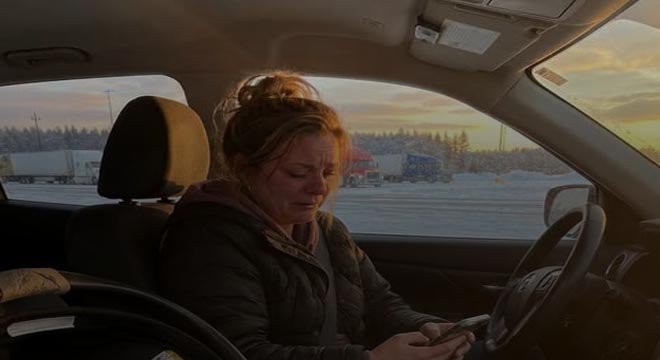
“Skip my
birthday. We need a break from your kid.” My mother’s text appeared on my phone as I waited at a red light in Kelso, Washington, with rain tapping against the windshield and my three-month-old daughter sleeping in the back seat. I had already driven nearly three hours from Seattle toward my parents’ home in Portland, stopping along the way to feed Maisie, and the wrapped birthday present I’d brought for my mother was still in the trunk. In the rearview mirror, I could see my daughter’s tiny mouth moving in her sleep, completely unaware that her grandmother had just decided she wasn’t welcome. The driver behind me honked when the light changed, and I pulled into a rest area, parked beneath a bare tree, and read the message again. There was no apology, no suggestion of another date, not even a gentle explanation that the gathering might be too much for a young baby. Just a request to stay away, expressed as though my child were an inconvenience everyone needed relief from. Instead of calling to argue or begging my mother to reconsider, I typed, “Understood. Hope you have a nice birthday,” turned the car around, and drove home, not knowing that two weeks later she would accuse me of betraying the family because of where Maisie and I chose to spend Thanksgiving.
My name is Jenna Hollis, and I was twenty-seven that autumn, working as a payroll and benefits specialist for a construction company in Seattle while raising my daughter alone. Being the dependable one had defined my place in the family for as long as I could remember. My older brother, Kyle, was the charming risk-taker who once persuaded me to lend him $3,000 for an app he never launched. My younger sister, Brinn, married two summers earlier, and I contributed $4,200 toward her flowers and photographer because my mother said she deserved a beautiful
wedding. When my parents needed repairs to the roof of their Portland home, I transferred $5,000 without being asked directly. I had also paid for the family cellphone plan for five years, covering four lines from my own account after my father’s credit problems made it difficult for him to maintain the service. None of these arrangements was forced upon me, but over time generosity became expectation. I was careful with money, good at budgeting, and accustomed to being praised more for what I could provide than for who I was. Things changed when I became pregnant. Maisie’s father, Derek, had been my boyfriend for nearly two years, a bartender with ambitions of becoming a musician and very little interest in making concrete plans. After learning I was expecting a baby, he spent several weeks avoiding serious conversations, then moved to Austin with another woman and changed his phone number. I chose to continue the pregnancy, frightened but certain I wanted my child. My mother’s reaction was to worry about what people would say. My father looked down at the kitchen table, Brinn spoke as though I’d suffered a terrible accident, and Kyle wanted to know whether Derek would pay child support. As my pregnancy progressed, I became increasingly aware of my family’s embarrassment. My mother stopped including me in church activities, described my pregnancy to an acquaintance as a “little situation,” and once reminded me that I’d chosen to have the baby when I called her crying about Derek. When Maisie was born in August after nineteen hours of labor, my best friend, Vanessa Kim, was the person beside me. Vanessa, a neonatal intensive care nurse whom I’d known since college, held my hand through the delivery and stayed until I was settled. My parents promised to visit the following weekend but didn’t arrive until three weeks later. My mother held Maisie briefly, remarked that she resembled Derek, and spent most of the visit discussing Brinn’s kitchen renovation. My father cradled her a little longer, and I noticed his eyes fill with tears before he looked away. I held on to that small moment because I wanted to believe there was still room for my daughter in the family. That was why I’d set out for Portland on my mother’s
birthday with a framed photograph of Maisie in a knitted hat, the words “Grandma’s Girl” printed in gold beneath it. After the text arrived, I returned to Seattle feeling foolish for having expected a warm welcome. Vanessa came over that evening with takeout, held Maisie while I showered, and listened as I described what had happened. She gently pointed out that my family had treated me with less consideration since I became a single mother, even as they continued depending on my money. I didn’t need her to tell me something was wrong, but hearing it from someone who loved me helped me acknowledge how much I’d been accepting. The following morning, I contacted the phone provider and arranged to move my number to a separate account, with advance notice to the other family members that they would need to assume responsibility for their own service. I stopped volunteering money for expenses that weren’t mine. My mother’s birthday passed without another message, and nobody called to ask whether Maisie and I were all right. I spent the day walking around Green Lake Park, watching ducks gather near the shore while my daughter stared wide-eyed from her stroller. For the first time in months, I felt no obligation to leave a peaceful afternoon because someone else might need something from me. Ten days later, Kyle called, not to ask about his niece but to complain about the phone notice. I told him he was thirty-one and could arrange his own account. Afterward, the family fell silent again. By Thanksgiving week, nobody had asked about our plans, which made the invitation I received from Vanessa all the more surprising.
Vanessa called on the Tuesday before Thanksgiving to explain that her friend Lauren Ashby had two unexpectedly vacant rooms at a private lodge in Montana. Lauren owned a successful organic skincare business, and each year she invited friends to a lakeside retreat for the holiday. Two couples had canceled, leaving space for Vanessa, Maisie, and me. Lauren was offering to cover our travel and accommodation, including the flight from a small airport near Seattle. I initially refused, uncomfortable accepting such generosity from a woman I’d met only twice, but Vanessa assured me that Lauren had invited us because she genuinely wanted us there. She had a two-year-old son herself and made a point of saying that babies were welcome. That word affected me more than the prospect of a beautiful lodge or a free holiday. On Wednesday morning, Maisie and I boarded a small chartered plane with Vanessa, and a driver met us in Bozeman for the journey to a log lodge beside a frozen lake. Pine trees rose around the property, snow-covered mountains filled the horizon, and warm light shone through enormous windows overlooking the water. Lauren greeted us at the door with her husband, Marcus, and their toddler, Cameron. Her business partner, Simone, and Simone’s fiancée, Beth, were there too. Almost immediately, Lauren asked permission to hold Maisie, smiling at her as though she’d been looking forward to meeting her all week. Cameron cautiously touched her head while Marcus reminded him to be gentle. The tenderness of that welcome caught me off guard, particularly after months of watching my own relatives treat my daughter’s presence as something awkward. That evening, once Maisie was asleep, I joined the others beside the fireplace and listened while Lauren explained why Vanessa’s account of my mother’s message had struck such a nerve. Lauren’s own father had left when she was two, and her mother had raised her alone in a trailer in Yakima, working two jobs while enduring disparaging remarks from relatives who treated single parenthood as a moral failure. Her grandparents’ disapproval had made Lauren feel unwelcome throughout her childhood, and she had never forgotten it. Her mother had sacrificed enormously to support her ambitions, even selling her car so Lauren could attend a summer business program as a teenager. Lauren told me she’d built her company because her mother had always believed she was worth investing in, and she wanted Maisie to grow up encountering that same sense of welcome. Thanksgiving dinner the next day was prepared by Rosa, a warm, practical chef whose kitchen smelled of roasted turkey, cornbread dressing, sweet potatoes, and fresh pies. We sat around a long table with candles flickering between the serving dishes, and when Maisie became fussy midway through the meal, Marcus offered to carry her so I could finish eating. Nobody sighed or suggested that I take her to another room. Later, Rosa noticed I’d barely touched my food and brought me a fresh plate, offering to hold Maisie while I ate. I began crying, embarrassed by how deeply such ordinary kindness affected me. Rosa sat beside me and explained that she’d had her first child at nineteen, without a husband, and that her own father had refused to speak to her for six years. She understood what it meant to feel judged at the very moment a young mother most needed support. By the end of the evening, I was comfortable enough to laugh, share stories, and allow other people to help without wondering what they expected in return. Before we left Montana, I took a photograph of the lodge reflected in the frozen lake beneath the morning sunrise and posted it on Instagram with a single word: “Grateful.” I didn’t tag the location or explain the trip. Two days after Thanksgiving, back in Seattle, my phone began filling with messages. My mother demanded to know why I hadn’t told them about Montana, Brinn suggested it was extravagant to take a luxury holiday while relatives were struggling, Kyle accused me of thinking I was too good for the family, and my father said my mother was upset that I’d kept my plans from them. Then another message arrived from my mother. She’d researched the lodge, discovered how expensive it was, and concluded that if I could afford such a trip, I should help pay their upcoming $3,800 property-tax bill. I stared at the screen, remembering that nobody had invited us to Thanksgiving or even asked whether we had plans. My family had not missed my daughter’s company; they had noticed the possibility that I possessed money they might need. I opened the family group chat and wrote a message explaining that friends had invited us, that Maisie had been welcomed and cared for, and that I would no longer pay the family’s expenses. I reminded them of the birthday text, the drive I’d made toward Portland, and the silence that followed. I told them that Maisie was their granddaughter and niece, not an inconvenience, and that if they wanted a relationship with her, it would have to be based on love and respect rather than money. After sending it, I set down my phone and picked up my daughter, knowing the message might permanently change the family relationships I’d spent my life trying to preserve.
The replies came quickly. Brinn accused me of airing private disagreements, Kyle wanted to know whether the cellphone arrangement was permanent, and my mother insisted that she’d only been joking about needing a break from Maisie. She accused me of changing since the baby was born, as though becoming less willing to tolerate disrespect were something shameful. I didn’t answer immediately, and for the next two weeks there was no meaningful contact. Then, on a rainy Saturday morning in December, my mother appeared unexpectedly at my Seattle apartment with my father, Brinn, her husband Josh, and Kyle. My mother opened by saying I’d humiliated her through the family group chat. She was particularly upset that my aunt Pam had seen the message, forwarded by Brinn. When I asked what Aunt Pam thought, my father quietly answered that she’d taken my side. Pam had confronted him, saying my mother was repeating the way their own relatives once treated her. I had never heard that part of our family history. My maternal grandmother, Ruth, had become pregnant at seventeen in 1966. Her parents sent her to a home for unmarried mothers in Tacoma and pressured her to surrender the baby for adoption, but she refused and raised my mother alone. Throughout childhood, my mother endured relatives and church acquaintances who treated her as a source of shame, referring to her simply as “Ruth’s girl” instead of using her name. Hearing this, I began to understand the panic that had gripped my mother when I became pregnant without a husband. She had spent her life trying to escape the same judgment and had responded by imposing it on her daughter. My father admitted he’d recognized the pattern but had repeatedly avoided confronting her because he didn’t want another argument. Then Brinn confessed that she’d asked our mother to discourage me from attending the birthday celebration because she planned to announce her own pregnancy there. She wanted the occasion to focus on her and Josh, and she feared that questions about Derek or Maisie’s father would distract from her news. She hadn’t intended our mother to send such a hurtful message, but she had helped create the situation. I congratulated my sister sincerely, then told my mother that I was sorry she’d grown up being made to feel ashamed of her own birth. But I also said that understanding her pain did not excuse passing it on to a granddaughter who was only three months old. I would not let Maisie grow up believing she belonged to a mistake. My mother listened without interrupting, something I had rarely experienced. Before leaving, she looked properly at Maisie for the first time that morning and remarked that my daughter had my eyes, which were also Ruth’s eyes. She reached out a finger, and Maisie grasped it in her tiny hand. The gesture didn’t resolve our disagreement, but it suggested that my mother was beginning to see the baby herself rather than the circumstances of her birth. My father returned alone shortly before Christmas, driving from Portland with a stuffed duck he’d bought for Maisie. He held her for hours, changed a diaper badly enough that we both laughed, and accompanied us to Green Lake so I could enjoy a meal while he carried her. He admitted that he’d known my mother was being cruel and had chosen silence because he disliked confrontation. Before leaving, he gave me a check for $12,200, together with a note listing the money I’d lent Kyle, contributed to Brinn’s wedding, and given my parents for the roof. He said he couldn’t undo the hurt but wanted me to know he had noticed what I’d done for everyone. I put the money aside for Maisie’s future and cried after he left, less because of the amount than because someone in my family had finally acknowledged the years of quiet giving. In January, Lauren called with an unexpected professional opportunity. Her skincare business had grown to 240 employees across three states, and she needed a director to oversee payroll and employee benefits. After confirming my experience and checking professional references, she offered me the job at nearly twice my previous salary, with mostly remote work and a strong benefits package. I accepted, grateful to find that the relationship begun through Vanessa’s friendship had grown into an opportunity based on my actual skills. That June, Brinn gave birth to a son named Oliver. I traveled to Portland with Maisie to meet my nephew, and my sister cried when I appeared in the hospital room. We talked about how she’d treated me during my pregnancy, and she admitted that after hearing a relative mock Oliver’s appearance, she’d finally understood the pain of my mother’s remarks about Maisie. When our mother arrived, she knelt beside Maisie on the hospital floor and lifted her into her arms, calling her by name and introducing herself as Grandma. It was a small moment, but one I had wanted since Maisie was born. Over the following months, our contact increased cautiously. My mother began asking about Maisie instead of discussing her as a problem, and she invited both of us to her sixtieth birthday dinner. I agreed to attend, explaining that we would leave if anyone spoke disrespectfully about my daughter. My mother accepted the condition and placed a new high chair beside her own seat. During dinner, Maisie smeared mashed sweet potatoes across the tablecloth, and when a guest commented on the mess, my mother defended her, saying that her granddaughter was welcome to enjoy herself. Kyle eventually found steadier work at an auto body shop and gave me a belated birthday card with twenty dollars toward the phone expenses he’d once expected me to cover. My father remained an attentive grandfather, often sitting with Maisie asleep against his chest long after everyone else had finished dessert. The changes were imperfect and sometimes uncomfortable, but they were real enough for me to remain open to them.
A year after I turned around on the highway outside Kelso, I drove that same route to Portland with Maisie asleep in her car seat. This time, we’d spent the evening celebrating my mother’s birthday, and my daughter had been welcomed as part of the family rather than treated as an inconvenience. I passed the rest stop where I’d parked beneath a bare tree and cried over the message that made me feel as though my little girl was unwanted. I didn’t pull in. I thought about how frightened I’d been of disappointing my parents, how often I’d tried to prove my worth by making their lives easier, and how becoming a mother had finally forced me to reconsider what I was teaching my daughter about love. I wanted Maisie to grow up knowing she could help others without surrendering herself, and that she never needed to earn affection by paying for it. My mother and I still had difficult conversations. She rarely apologized directly, and there were moments when old habits emerged before she caught herself. But she was learning to speak about Maisie with pride, and I was learning that I could recognize my mother’s troubled childhood without accepting the same treatment for myself. Our relationship with Brinn grew stronger after Oliver’s birth, particularly as we shared the practical worries and joys of raising small children. Kyle gradually became more independent, and my father remained the person who consistently showed up, even when doing so required an uncomfortable conversation. Vanessa was still my closest friend, frequently visiting after her hospital shifts with food or an excuse to spoil Maisie, and Lauren’s family had become an unexpected source of warmth and encouragement. At work, I enjoyed the challenge of managing a growing company’s benefits program and the flexibility to spend more time with my daughter. I no longer felt compelled to explain every financial decision to relatives who had once assumed my paycheck was available to them. Instead, I began planning seriously for Maisie’s future, building savings and creating routines that made our small home feel peaceful. Thanksgiving was approaching again, and Lauren had invited us back to the Montana lodge. Vanessa would be there, along with Simone and Beth, now married, Rosa, and Lauren’s family. Lauren had even suggested including my father, who eagerly accepted and bought a new pair of snow boots for the trip. My mother was invited too, but she wasn’t ready to join us that year. Rather than criticizing the invitation, she sent me a brief text asking me to thank my friends for being kind to her granddaughter and admitting she was still learning. I saved the message beside the one she’d sent the previous autumn. Seeing the two together reminded me how much could change when people were finally asked to confront the effect of their words, and how slowly that change sometimes came. Maisie was fourteen months old by then, walking in an unsteady, determined little march and calling nearly every living creature a duck. She called dogs ducks, pigeons ducks, and once pointed at a passing fire truck and shouted the same word with such conviction that Vanessa nearly fell over laughing. On a clear Sunday afternoon, I took her to Green Lake Park, where we’d spent my mother’s birthday the year before. The trees were nearly bare, the air was crisp, and the water flashed silver beneath the autumn sun. Maisie insisted on walking rather than riding in her stroller, holding one of my fingers with her entire hand and stopping every few steps to inspect a leaf or point at something moving. When we reached the shore, a group of ducks paddled toward us, and she released my hand, spread her arms, and shouted her favorite word again and again. I stood close behind her, watching the pure delight on her face, and tried to imagine what it would be like to approach the world with that much confidence that something wonderful was waiting. Then I took out my phone and photographed her in her purple boots, arms stretched toward the birds. I posted the picture with the same single word I’d used beneath the photograph of the Montana lodge: “Grateful.” Within a minute, the first person to like it was my mother. I looked at the notification, then back at Maisie, who was still waving enthusiastically at the ducks, and slipped the phone into my pocket. My daughter turned toward me, laughing, and reached for my hand. I took it, and we continued around the lake together.