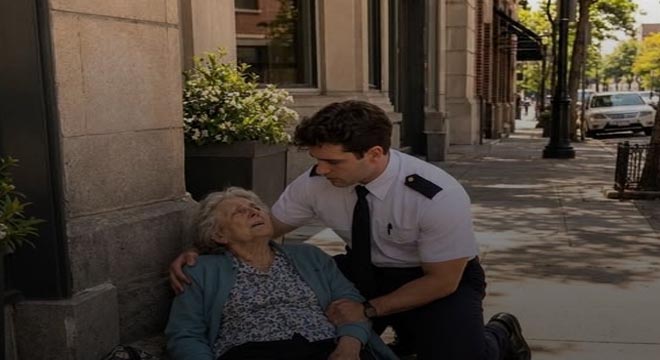
“You should have kept driving.” My boss, Gavin Mercer, stood in my office doorway, his expensive navy suit perfectly pressed and his face as cold as the rain still dripping from my coat. Twenty employees sat within earshot, suddenly fascinated by their computer screens, while I explained for the third time that I’d stopped on Route 18 because an elderly woman had collapsed beside her car and could barely breathe. Gavin wanted to know whether she was my wife or my mother, and when I said she was a stranger, he told me I’d cost the agency a $3.8 million advertising account by missing an eight-thirty presentation. I reminded him that I’d called from the roadside, that the campaign materials were ready, and that a 911 dispatcher had instructed me to stay with the woman until paramedics arrived. He looked at me as though I’d confessed to some unforgivable professional failure and told me to clear out my desk immediately. Four years of late nights, rescued client accounts, missed family dinners, and weekends spent repairing other people’s mistakes ended with a demand to surrender my security badge. Less than four hours later, that same woman would return to our offices accompanied by two attorneys and a corporate security investigator—and what they discovered on my company laptop would turn my dismissal into the smallest problem Gavin Mercer faced that day.
My name is Christopher Bennett, and I was thirty-eight when I lost my job at Mercer & Field, a marketing agency in Westchester County, New York. I was divorced, raising two daughters with my former wife, Sarah, and trying to keep up with a life that had become increasingly expensive. Sophie, fourteen, attended St. Agnes and wanted to study marine biology. Lucy, nine, had a habit of hiding tiny plastic astronauts in my briefcase because she thought offices needed something interesting in them. My mortgage was $2,140 a month, child support was $1,600, and Sophie’s school tuition came to $6,800 each semester. After insurance, car payments, utilities, and other expenses, I had roughly $11,000 in savings—enough to survive for a few months without work, but not enough to feel secure. On the morning everything changed, I’d left home early to make final preparations for the most important client presentation of the year. Whitcombe Foods was considering a three-year contract worth $3.8 million, and I’d spent weeks building the campaign strategy. Gavin had sent an email the previous Friday reminding everyone that lateness would not be tolerated. At approximately eight o’clock, while driving past the reservoir on Route 18, I noticed a dark gray Mercedes pulled partly onto the shoulder. An older woman stood beside the open driver’s door, gripping it with one hand while pressing the other against her chest. I initially assumed she was searching for something she’d dropped. Then her knees buckled, and she disappeared behind the door. Two vehicles ahead of me slowed but continued driving. For a moment, I almost did the same. I thought about the presentation, my boss’s temper, and the consequences of arriving late. Then I looked into my rearview mirror and realized she was still lying on the gravel. I braked, pulled over safely, called 911, and ran back toward her. She had silver hair, wore a navy wool coat, and was breathing irregularly. Her lips were grayish, her hands cold. Following the dispatcher’s instructions, I monitored her breathing, helped keep her in a safe position, and spoke to her while waiting for emergency medical personnel. She repeatedly asked me not to let her close her eyes. I talked about Sophie, Lucy, their plans for the future, and the miniature astronauts Lucy hid around my desk. I even told her about the terrible parking at my office because I couldn’t think of anything else. When the ambulance arrived nineteen minutes later, the paramedics took over and transported her to the hospital. I never learned her name. I called Gavin from the roadside, but by the time I reached the office, the Whitcombe representatives had already left. Gavin said the company’s leadership couldn’t trust a strategist who put a stranger ahead of a major account, and he terminated my employment on the spot. I sat in my car in the parking garage for twenty minutes, staring at the concrete wall beyond my windshield. Then Sarah called. She could hear something was wrong before I told her. When I explained, she was sympathetic, but we both understood the practical consequences. Sophie had a tuition payment due Friday, my health coverage would soon change, and I had no guarantee of finding comparable work quickly. I drove to Marlene’s, a diner where Sarah and I used to eat when we were newly married, and ordered coffee. Marlene, the waitress who’d known me for years, listened to the story and told me that sometimes losing a job reveals more about an employer than keeping it ever could. I appreciated the sentiment, but I still had bills to pay. I opened my laptop and began revising my résumé. Half an hour later, Nina, the agency receptionist, started calling. I ignored the first two calls, assuming Gavin wanted another unpleasant conversation. Then she texted that the woman I’d helped was at Mercer & Field asking for me. I called immediately to ask whether she was all right. Nina said she appeared to have recovered but had arrived with several people, including attorneys representing Halston Capital. My stomach tightened. Halston Capital was one of the country’s most influential private investment firms, with holdings in real estate, healthcare, logistics, and technology. I knew the firm by reputation, although I had no idea why its lawyers would be standing in my former workplace. Nina said Gavin had been in the conference room with them for several minutes and looked terrified. I returned to the agency, telling myself I was only there to retrieve my belongings. Through the glass wall of Conference One, I recognized the woman from the roadside, now wearing a cream blouse beneath the navy coat I’d seen covered in gravel. She came out to meet me and held both my hands. Her name was Eleanor Halston. She and her late husband, Walter, had founded the company decades earlier, and after his death she’d expanded it into a multibillion-dollar investment operation. She told me doctors had treated her for a dangerous heart-rhythm disturbance and that stopping when I did had likely prevented a much worse outcome. When she asked what happened after the ambulance left, Gavin tried to interrupt. Eleanor noticed the cardboard box in my hands and pressed him for an explanation. He admitted he’d fired me. She asked whether he’d really told me to keep driving, and I repeated his words exactly. Eleanor then revealed that Halston Capital had been conducting confidential due diligence on Mercer & Field for six months, considering an acquisition of a controlling equity interest based on a preliminary valuation of $18 million. The transaction was subject to negotiations, financial verification, legal review, and final approval. Hearing how Gavin had handled the emergency, Eleanor instructed her advisers to withdraw from the proposed deal. Her team also reviewed the professional records our agency had supplied during due diligence. Those records showed that campaigns I’d led or substantially developed accounted for approximately thirty-one percent of retained client revenue over the preceding three years, and I’d played a major role in winning four of our six newest accounts. Gavin had never given me that information. When Eleanor asked why he’d dismissed an employee with such a record, he attempted to offer me immediate reinstatement. I declined. Then she handed me a business card and invited me to interview for a senior position at Halston. I thanked her, surprised that an investment executive would consider hiring an advertising strategist, and began collecting the photographs, coffee mug, and headphones from my desk. Before I finished, Eleanor’s general counsel, Mr. Albright, entered the room with an urgent message. Halston’s cybersecurity team had detected copies of confidential acquisition documents on a Mercer & Field computer. The device was my company laptop, and the files appeared to have been transferred using my employee account the previous night. I hadn’t even known the acquisition negotiations existed. Yet a folder bearing Halston’s name had appeared on my desktop, and Gavin, who moments earlier had wanted to reinstate me, suddenly looked desperate for me not to touch the computer.
Eleanor asked her head of security, Daniel Reyes, to preserve the device and coordinate with Halston’s cybersecurity specialists. Daniel had spent more than two decades in federal law enforcement before entering corporate security, and he approached the matter without assuming that a suspicious user account proved who had performed the transfer. A technical analyst named Priya examined the available device and access logs. They showed that the confidential material had been copied at 11:42 the previous evening, during a period when I was still in the office finishing Whitcombe’s presentation. I remembered going downstairs for coffee because our floor’s machine was broken. Gavin had been there shortly beforehand, and he’d asked me to bring him a cup. I had left my laptop unattended for several minutes. The forensic review indicated that a USB storage device had been connected during that interval. Investigators recorded the device identifier and discovered that a flash drive with the matching identifier was connected to Gavin’s desktop computer. That finding did not, by itself, establish the whole chain of responsibility, but it was serious enough for counsel to secure the equipment, preserve access logs, and arrange an independent investigation. Gavin initially denied knowing anything about the drive. When questioned further, he claimed his business partner, Richard Field, had wanted access to confidential acquisition materials. Field owned forty-nine percent of Mercer & Field but had stepped back from daily operations years earlier after disagreements over employee treatment and management practices. His lawyers confirmed that he’d been asking for appropriate financial information about the proposed sale, but he denied requesting Halston’s confidential internal documents. Investigators later uncovered evidence suggesting Gavin had copied those materials to create leverage in the negotiations and shifted them onto my laptop to divert suspicion. Under the shareholder agreement and applicable corporate governance procedures, Field and the company’s advisers began steps to suspend Gavin from management pending further investigation. Eleanor’s firm withdrew from acquisition negotiations and considered the potential contractual and legal remedies arising from the breach. I should have felt relieved to be cleared of suspicion, but before I could collect my thoughts, Daniel received a troubling update about the morning’s emergency call. Someone had reported an older woman in distress beside Route 18 shortly before I placed my own call. The anonymous caller had used a prepaid telephone and had known enough to identify her as elderly. The timing and circumstances suggested he might have been observing Eleanor before her collapse. Daniel asked her about her routine that morning. She’d stopped at the same bakery she visited every Monday, purchasing pastries and coffee before continuing toward her office. Her granddaughter Claire and Claire’s husband, Marcus Vale, had known about those plans because she’d mentioned them at dinner the previous evening. Marcus was a prominent property developer whose companies had borrowed heavily from Halston-backed lending funds. A recent internal audit had raised serious questions about several of those loans. According to the preliminary findings, approximately $46 million might have been diverted through affiliated companies and transactions supported by misleading development reports. Some purported projects were dramatically overvalued; others had made far less progress than the borrowers’ submitted draw requests suggested. The audit had not yet established every fact, but the potential exposure was enormous. Marcus therefore had a strong financial interest in delaying the release of damaging information, and investigators needed to determine whether the strange roadside call was connected. Claire arrived at Halston’s offices after learning her grandmother had been hospitalized. She explained that Marcus had told her about the medical emergency unusually early, before the family had received formal notification. She also remembered he’d left home before sunrise, returned with mud on his expensive
shoes, and later burned a tan coat in his study. I suddenly recalled seeing a dark sedan parked near the reservoir fence while helping Eleanor. A man in a tan coat had stood beside it, several hundred yards away, apparently watching. I had assumed he was calling for assistance. Now I wondered why he hadn’t approached. Claire then produced an envelope of photographs she’d discovered in her husband’s safe days earlier. Most showed Eleanor entering buildings, visiting restaurants, or following familiar routes. One photograph appeared to show me kneeling beside Eleanor on the Route 18 shoulder, although Claire insisted she’d found it before the accident. Daniel examined it closely and pointed out differences. The man wore a charcoal coat resembling mine but lacked the small tear near my cuff. The woman and car were similar in appearance to Eleanor and her Mercedes, but neither was an exact match. The image appeared staged. The investigators began treating the photographs as evidence of possible planning rather than proof of what had actually occurred. Then they asked for my full legal name and whether I had ever used another surname. I said I’d been born Christopher Vale. My biological father had disappeared from my life before I could remember him, and I was raised by my mother, Laura, until she married Jim Bennett, who adopted me when I was five. Jim had been the father who taught me to ride a bicycle, coached my Little League team, and stood beside me at every important moment until his death. Claire went pale when she heard my original surname. Marcus, she said, had an older half-brother named Thomas Vale who’d been estranged from the family after a relationship with a waitress named Laura. My mother’s name was Laura. I had no memory of Thomas, but I remembered anonymous birthday cards arriving during my childhood, usually containing twenty dollars and signed with the letter T. The cards stopped when I was eight. After obtaining documentation through appropriate channels, investigators confirmed that Thomas Vale was my biological father and had died in a car accident when I was eight. He had held an ownership interest in a family real-estate partnership at his death. The estate history was complicated, and any claim I might have as his surviving child would require probate analysis, proof of parentage and heirship, review of the partnership documents, and consideration of any prior estate proceedings. But records suggested Marcus had treated Thomas’s interest as though it belonged to other members of the family and later used partnership assets as collateral for substantial development financing. The potential value of the disputed interest reached into the tens of millions, depending on the validity of the transactions, outstanding debts, and later court findings. Among Marcus’s files was a genealogy report identifying Christopher Bennett as the adult son of Thomas Vale, together with my employer and regular commuting route. Suddenly the staged photograph, the stolen acquisition files, and the roadside emergency formed an ugly pattern. If investigators or reporters could be persuaded that I was a previously unknown Vale heir attempting to ingratiate myself with Eleanor, my credibility in any future inheritance dispute might be damaged. A public scandal involving Halston’s confidential documents could also distract from the pending investigation into Marcus’s borrowing arrangements. The evidence suggested Marcus had been preparing such a story for months, using Gavin’s financial vulnerability and access to Mercer & Field to place incriminating documents where they could be attributed to me. While investigators worked to establish the details, an unknown number sent a photograph of my house to my phone. Through the front window, Sophie and Lucy were visible sitting in the living room. Beneath the picture were five words: YOU SHOULD HAVE KEPT DRIVING. I called the police and then my daughters, instructing them to remain inside and follow the dispatcher’s advice until officers arrived. Sarah came to collect them after police confirmed the house was secure. No one had entered the property, but the threat was unmistakable. When Sophie asked whether helping Eleanor had been worth everything that followed, I told her it was. I wanted my daughters to know that if they were ever in danger beside a road, they deserved to have someone stop. I had believed I’d lost my job because I chose to help a stranger, but the documents, photographs, and threats now suggested that someone had been preparing to destroy my reputation long before I ever pulled onto the shoulder—and the very decision that cost me my job had left a recorded trail capable of disproving his story.