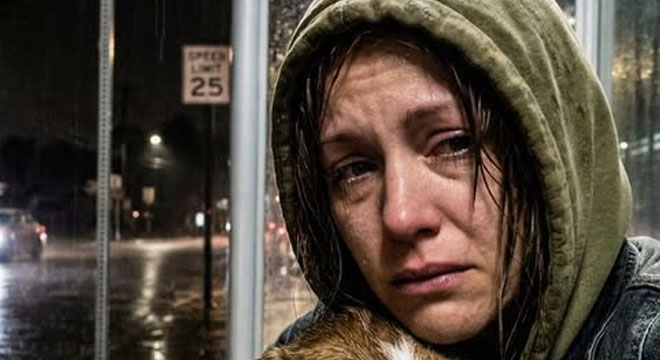
Three years ago, I was sitting in my freezing apartment, staring at my bank app, which showed a balance of $12.43.
I remember that number because I kept looking at it, as if it might change out of pity. It did not. Twelve dollars and forty-three cents.
- I Bullied a Girl in High School for Years – 10 Years Later, She Was Conducting My Dream Job Interview

I’ve been trying to break into a niche industry (30-40 jobs in a city with a population of 3 million) for a while […]
- I Let a Homeless Woman Sleep on My Porch for One Night – What She Left Under the Doormat Made Me Drop to My Knees

I was 49, widowed, and it felt like my life had been on pause since my daughter went missing at the county fair. One […]
That was everything I had to my name at 27 years old.
The radiator in my apartment made more noise than heat. The window by my mattress did not close all the way, so cold air kept slipping through the crack and brushing against my neck.
I was behind on rent, barely eating, and honestly wondering if sleeping in my car would be warmer.
I had half a loaf of stale bread on the counter, one bruised apple, and a packet of instant noodles I had already decided to save for the next day. My phone sat in my lap while I did the math again, even though I knew the answer would stay cruel.
Rent or food.
Gas or soap.
Survive this week or survive the next one.
That was my life back then.
Small choices that felt enormous. I had no family to call, no safety net tucked away somewhere, and no one waiting to ask if I had eaten. I had gotten good at making myself smaller, quieter, and easier to ignore. Some days, that felt like the only talent I had left.
That’s when I heard scratching at my door.
At first, I thought I had imagined it. I lifted my head and listened. There it was again. Weak, uneven, desperate.
I got up, pulling my old sweater tighter around me, and opened the door.
A starving, shaking dog had collapsed on my doorstep.
He was thin enough that I could see the shape of his ribs through his dirty fur. One ear was bent strangely, and his paws looked raw from too much walking on cold pavement.
He tried to lift his head when he saw me, but he barely managed it. His eyes were dark, tired, and somehow still gentle.
I knew I couldn’t afford to help him.
That was my first thought, and I hated myself for it the second it crossed my mind.
I crouched down slowly.
“Hey, sweetheart,” I whispered.
He flinched, not from me, but from the sound of my voice, like he was bracing for disappointment. My chest tightened. I should have gone back inside, closed the door, and protected what little I had left. That would have been the smart thing.
But when he looked at me… I couldn’t walk away.
I slid my arms under him, surprised by how light he was.
He trembled the whole time I carried him inside.
I laid him on the blanket I used at night and knelt beside him, trying not to panic. He smelled like rain, dirt, and something older, like he had been surviving alone for far too long.
“It’s okay,” I told him, though I was not sure if I meant him or myself.
I took my last money and went to the corner store for food and ointment. The cashier, a woman named Doreen who had seen me buy instant soup more times than I wanted to admit, looked into the bag and frowned.
“You got a dog now?” she asked.
“Looks like he got me,” I said, and for the first time in weeks, she smiled.
I named him Barnaby that night. I do not know why. He just looked like a Barnaby. Gentle. Worn out. Still trying.
For the next three years, it was just us.
We lived in my car for a while after I lost that apartment. I would crack the windows at night, curl up in the front seat, and keep one hand on him while he slept in the back.
When I cried, which happened more than I like to admit, Barnaby would push his nose against my shoulder until I laughed through it.
Later, we moved into a tiny trailer that leaned slightly to one side and smelled faintly of damp wood. It was not much, but it had a door that locked and enough floor space for Barnaby to stretch out in the sunlight.
That felt like luxury to me.
He was my only support, the reason I kept going. On the days when I wanted to give up, I would look at him and think, not yet. Not while he still needs me.
I never removed his old, worn collar. I tried a few times, especially when it started fraying near the buckle, but he always resisted, like it meant something to him. So I left it alone.
Yesterday, things fell apart again.
My hours got cut, and I was facing eviction. I sat on the floor, crying into his fur, my hands knotted in the thick hair around his neck while he stayed close and still, as if he knew this was one of the bad moments.
Then someone knocked on the door.
Three sharp knocks.
I froze, thinking it was the landlord.
But when I opened it, a man in an expensive suit stood there, with two others behind him.
He looked at Barnaby.
And his eyes filled with tears.
Then he looked at me and said something that made my blood run cold.
“That dog belongs to my mother.”
For a second, I could not breathe.
My hand tightened on the edge of the door, and every muscle in my body went rigid. Barnaby had moved up beside my leg, pressing against me the way he always did when he sensed I was afraid.
“You mean Barnaby?” I asked, my voice barely above a whisper.
The man swallowed hard. Up close, he looked to be in his early 50s, polished and put together in a charcoal suit that probably cost more than everything I owned. But his face did not look cold anymore. It looked wrecked.
He glanced at Barnaby again, and his eyes shone.
“His name wasn’t Barnaby,” he said quietly. “My mother called him Winston.”
I took a step back. “No. You don’t get to show up here and make claims like that.”
“I know how this sounds,” he said, lifting a hand. “Please. I’m not here to take him from you.”
The two people behind him stayed silent. One was a woman with a tablet tucked against her chest, and the other was an older man holding a file. Something about that made my stomach twist even more.
“How did you even find us?” I asked.
The older man cleared his throat. “The collar.”
I looked down at it instinctively, at the same faded leather strap Barnaby had worn since the day I found him. Dirty, worn, cracked near the buckle. Ordinary.
“The collar has a hidden microchip,” the woman explained gently. “It was custom-made. Your dog was scanned at a low-cost vet clinic two weeks ago, after a routine vaccine. The chip was flagged and linked to an estate record.”
I stared at her.
Then I looked at Barnaby.
Winston. Barnaby. My dog. Their dog. The room felt like it had tilted.
The man drew in a shaky breath. “My mother was very wealthy. She lived alone after my father died. That dog was everything to her.”
His voice faltered. “We were estranged for years. We said terrible things to each other, and I kept thinking there would be time to fix it.”
Barnaby looked up at him, ears twitching, as if some distant memory had stirred.
The man’s expression softened.
“A month before she passed, Winston disappeared during a storm. She never recovered from it. She kept hoping someone decent had found him.”
I felt tears sting my eyes, but I did not let them fall yet. “And now what? You expect me to hand him over?”
“No,” he said at once. “No. That’s not why I’m here.”
He looked around my tiny trailer, taking in the patched curtains, the leak stain near the sink, the folded eviction notice on the counter that I had forgotten to hide. His face changed then. Not with judgment.
With understanding.
“I came because my mother left instructions. If Winston was ever found, the person who cared for him was to be thanked properly. Generously.”
The older man opened the file and handed me a document, but I could barely focus on the words.
“There’s a reward,” the man said. “A large one. And my mother’s cottage, the one on her property, is vacant. I want you to have it if you want a place to live. No rent. No catch.”
I looked at him in disbelief. “Why would you do that for me?”
His eyes filled again.
“Because you did for him what I failed to do for her. You stayed.”
That broke me.
I covered my mouth and started crying right there in the doorway, the kind of crying that comes from too many years of fear, hunger, and holding yourself together with nothing but stubbornness. Barnaby leaned into me, warm and steady, and I sank down beside him.
The man crouched a few feet away, careful not to come too close. Barnaby sniffed the air, then walked toward him slowly. When the man held out a trembling hand, Barnaby touched it with his nose.
We both started crying harder after that.
A week later, I stood outside the little cottage with Barnaby beside me, the keys cold in my palm and the morning sun warming my face. It had white shutters, a real porch, and a yard big enough for him to run in.
I could hear birds instead of traffic. For the first time in years, I did not feel like life was about to collapse under my feet.
I still called him Barnaby sometimes. The man, whose name was Elias, never minded. “Maybe he needed both names,” he told me once with a sad smile.
Maybe he did.
All I know is that three years ago, I opened my door with $12.43 in my bank account and nothing left to give. But I gave it anyway.
And somehow, the starving, shaking dog that collapsed on my doorstep ended up saving me right back.