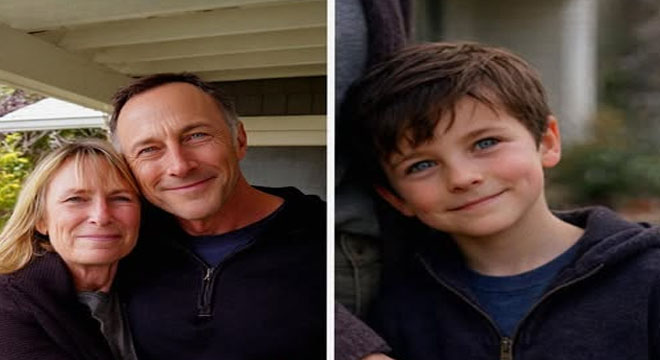
My name is Marlene. I’m fifty-two, and for two years I believed I had already faced the hardest part of losing my husband.
Thomas and I had been married twenty-seven years. When he died, I thought the worst of it would be the empty side of the bed, the quiet house, the way his slippers stayed tucked under the dresser like he might come back for them.
I was wrong.
A week after the funeral, I opened his desk drawer to organize paperwork. His glasses were still resting on a stack of bills. His coffee mug had left a faint ring on the wood.
That’s when I found the folder.
“Partnership Agreement.”
Inside were contracts and a schedule of monthly wire transfers to a woman named Grace. I had never heard that name in nearly three decades of marriage.
At the bottom of one page, in Thomas’s careful handwriting, was a note:
“Payments must continue. No matter what.”
No matter what.
The words felt heavy. Final.
I took the documents to our attorney the next day. He read everything twice before looking up at me.
“It’s legitimate,” he said. “You’re legally required to continue the payments as executor of the estate.”
“Who is she?” I asked.
He shook his head. “I don’t know. But Thomas signed this five years ago.”
Five years. While we were planning retirement. While we were booking vacations and hosting dinner parties.
That afternoon, I called the number listed on the contract.
“Hello?”
“Is this Grace?” My voice trembled.
“Yes.”
“My name is Marlene. I’m Thomas’s wife.”
There was a pause.
“I know who you are,” she replied softly.
I told her Thomas had passed. She said she was sorry. When I asked what the partnership was for, she answered carefully.
“We invested together years ago. He wanted the payments to continue, no matter what happened to him.”
She gave me nothing more.
For two years, I sent the money. On the first of every month, without fail. Each transfer felt like swallowing something sharp.
I told myself it was business. That grief makes you forget details. That Thomas had his reasons.
But the questions never stopped.
Who was she?
What was I paying for?
Why had he never told me?
Last Thursday, there was a knock on my door just after dinner.
When I opened it, a woman in her thirties stood there holding the hand of a small boy. He couldn’t have been older than six. Dark hair. Curious eyes.
And a dimple in his left cheek.
The same dimple Thomas used to call “the family trademark.”
“You’re Thomas’s wife?” she asked.
I couldn’t take my eyes off the boy.
“I’m Grace. We need to talk.”
I stayed in the doorway.
“Start talking.”
She looked exhausted, like someone who had carried a secret too long.
“I didn’t plan to come today,” she said. “But I need to ask if the payments can increase. Things have gotten harder.”
Rage flared instantly.
“So that’s it? You show up with a child who looks like my husband and ask for more money? Were you his mistress?”
Her face crumpled.
“No. Thomas didn’t betray you.”
Then she handed me an old photograph.
Thomas. Young. Seventeen, maybe eighteen. A letterman jacket. Standing beside a smiling girl I didn’t recognize.
“My mother,” Grace said. “They dated in high school. Everyone thought they’d marry.”
I felt the world tilt.
“She left town before graduation. Never told him she was pregnant.”
Silence swallowed the room.
“I’m his daughter,” Grace said. “We found out seven years ago. My mother was dying. She told him the truth.”
She showed me DNA results. 99.9 percent match.
Thomas had taken the test immediately.
“He wanted to tell you,” Grace whispered. “I stopped him. I didn’t want to shatter your marriage because of my mother’s mistake.”
“That wasn’t your decision,” I said.
“I know.”
Her husband had died in a car accident five years earlier. Thomas stepped in quietly. The “partnership agreement” was a legal way to provide for his daughter and grandson without creating scandal or suspicion.
The boy tugged her sleeve and looked at me.
“Are you my grandma?”
The question landed in my chest like a stone.
“What’s your name?” I asked him gently.
“Oliver.”
He smiled, and there it was again—the dimple.
After they left, I couldn’t sleep.
I drove to Thomas’s hometown two days later. Spoke to an old classmate. Everything Grace said checked out. Thomas and her mother had been inseparable. She’d left suddenly. He’d been heartbroken.
He hadn’t known he had a daughter.
I came home and reread the note.
“Payments must continue. No matter what.”
I heard it differently now.
Not a lover hiding betrayal.
A father trying to repair lost time without destroying the life he’d built.
I remembered a night four years ago when Thomas had sat at the edge of our bed, staring at his hands.
“What’s wrong?” I’d asked.
“Nothing,” he’d said softly. “I just love you.”
Now I understood. He had been carrying two truths at once.
I invited Grace and Oliver back yesterday.
This time, I opened the door fully.
Oliver wandered into the garden and laughed at the wind chimes. The sound was so much like Thomas’s laugh that I had to steady myself against the counter.
This child carried the man I loved. In his smile. In his posture. In the way he tilted his head when he was curious.
For two years, I believed I had been grieving a stranger.
But maybe that isn’t true.
Maybe I was grieving a complicated man who tried to protect everyone at once—and failed at telling the truth in the process.
Love doesn’t erase secrets.
But sometimes, it outlives them.
And now, when Oliver smiles at me from across the garden, I don’t just see betrayal.
I see something Thomas left behind that I never knew I would one day call family.