The afternoon started like any other busy day in my salon, the kind where the blow dryers never seem to stop humming, the front desk phone rings before anyone finishes a sentence, and every chair is full long before lunch. Then, without warning, a pipe in the shampoo room burst so violently that it sounded like something had exploded behind the wall. Water shot across the floor, raced beneath the cabinets, and spread so fast that my staff began shouting over one another while clients scrambled to move their bags and shoes out of the flooding. I remember standing there for one stunned second, staring at the rising water and the expensive equipment we kept in that back room, and thinking that if we lost the shampoo stations, the massage chairs, and the electrical system, I might be watching years of work disappear in a matter of minutes.
I was close to tears when a young man in dirty overalls came running through the front door carrying a heavy wrench. He said he was a handyman, had seen the chaos from his truck, and knew enough to help before the damage got worse. At first, I barely had time to register how young he was. He couldn’t have been older than twenty-one, maybe twenty-two at most, but there was something in his face that made him look older than that, something tired and guarded, like life had already asked too much from him. He didn’t waste time talking. He just dropped to his knees in the water, followed the line, found the valve, and worked so quickly and frantically that everyone in the room went silent and watched him like he was the only person who mattered. Within minutes, he had shut the main flow off and patched the line enough to stop the flooding from getting worse. He saved my salon from a disaster I still believe would have ruined me.
When it was over, I rushed to get my purse because I wanted to pay him immediately and generously. That kind of work, that kind of urgency, and that kind of skill deserved far more than a few bills and a thank-you. But when I tried to hand him the money, he just shook his head and gave me a small, tired smile. He said not to worry about it, that he was just glad he could help, and there was something so strange about the way he said it, as if helping people was the one thing in the world he was still trying to believe in. I looked at him more closely then. His overalls were thin and worn, his boots were scuffed and nearly splitting at the seams, and his hands were rough in a way that told me he had done real labor for a long time. He looked exhausted in a way makeup or sleep could not have fixed, the kind of exhaustion that comes from carrying too much responsibility and not enough rest. I didn’t know why, but I felt immediately that I could not let him walk away without doing something more for him.
I begged him to come back the next day when things were calmer. At first he refused, and I could tell he was the kind of person who didn’t know what to do when someone offered him kindness without asking for anything in return. I told him I wanted to give him a free makeover, a full luxury treatment, the kind of pampering we gave clients who came in for birthdays, weddings, or after difficult seasons in their lives. I told him I wanted him to sit in a clean chair, get his hair cut and styled, have his skin treated, and leave feeling like someone had remembered he existed. He laughed awkwardly and said it wasn’t necessary, but I could tell my persistence was wearing him down. Eventually, he agreed, though only after I promised him it would not cost him a cent.
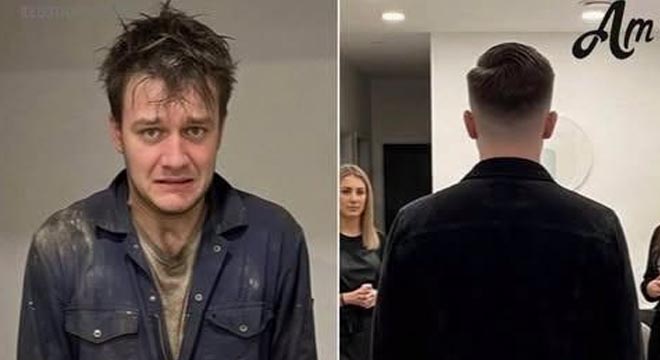
He came back today just before noon, quieter than before and even more uncomfortable in the waiting area, as if he expected someone to tell him he didn’t belong there. My staff treated him kindly from the start. One of the stylists offered him coffee, another brought him water, and my best makeup artist said she had already picked out products that would brighten his face without making him feel overdone. He kept thanking everyone, which made my heart ache more than I expected it to. During the makeover, he barely spoke. He sat still while his hair was washed and trimmed, while the tiredness seemed to lift from his face, while the stubborn lines of stress softened little by little. He looked so different by the time we were done that several people in the room paused to stare. Not because he had been ugly before, but because the weight he had been carrying seemed to vanish just enough for the person underneath to finally show through.
He came back today just before noon, quieter than before and even more uncomfortable in the waiting area, as if he expected someone to tell him he didn’t belong there. My staff treated him kindly from the start. One of the stylists offered him coffee, another brought him water, and my best makeup artist said she had already picked out products that would brighten his face without making him feel overdone. He kept thanking everyone, which made my heart ache more than I expected it to. During the makeover, he barely spoke. He sat still while his hair was washed and trimmed, while the tiredness seemed to lift from his face, while the stubborn lines of stress softened little by little. He looked so different by the time we were done that several people in the room paused to stare. Not because he had been ugly before, but because the weight he had been carrying seemed to vanish just enough for the person underneath to finally show through.
An hour ago, when we finished, I brought him over to the mirror myself. I spun the chair around and waited for him to smile, because that is what people usually do in moments like that. They laugh, they touch their new haircut, they stand a little straighter, and they let themselves enjoy being seen. But the second he looked at his reflection, his whole face changed. He didn’t smile at all. He went perfectly still, and for a moment I thought I had done something wrong. Then his eyes filled, and he looked away from the mirror as if the sight of himself was too much to take in. The entire room fell silent. My staff froze. Even the clients who had been waiting nearby stopped talking. Something in his expression told me this was not a simple reaction to a good haircut, and I suddenly felt the first stab of panic that maybe I had crossed a line by making a struggling young man the center of attention.
He swallowed hard and then said, in a voice so quiet I almost missed it, that he hadn’t seen himself properly in years. Not really seen himself, not as someone worth cleaning up for, not as someone who could stand in a room like this and belong. Then he reached up and touched the side of his face, almost like he was checking whether the man in the mirror was real, and he told us why. He said he had not come here because he was trying to build a business or make a name for himself. He had come because he had been patching pipes and fixing leaks since he was sixteen, because his mother had cleaned buildings and offices her whole life, because she used to bring him into salons like mine when he was little and tell him that people who worked with their hands deserved to be treated with dignity, and because after she died, he had spent years bouncing between relatives, couches, and cheap motel rooms trying to keep himself and his younger sister alive. The room went so quiet I could hear the air conditioner kick on.
He looked at me then, and I could see the shame and the exhaustion in his eyes all at once. He said he had almost refused the makeover because he was afraid of what it would mean to be seen, because every time someone had ever offered him kindness, it had come with pity, and pity made him feel smaller than the dirt on his boots. But this, he said, this was different. This was the first time in a very long time that anyone had offered him something beautiful without asking him to earn it first. His voice cracked when he said it, and then, to my complete shock, he put his hand over his mouth and cried. Not a few tears, not a shaky breath, but the kind of full, sudden grief that comes out when a person has been strong for too long and finally runs out of places to hide the pain.
No one in the room moved. My stylists stood still. The receptionist stared at the floor because she didn’t want to make him feel watched. One of the clients had tears in her eyes. I felt my own throat tighten because I realized that what I had thought was a simple act of kindness had touched something much deeper than I understood. He wasn’t crying because he loved his haircut. He was crying because he had spent years believing that survival meant staying invisible, and for the first time, someone had tried to see him as more than a man with dirty hands and worn-out clothes.
I told him that he had saved my business, that what he did for me mattered, and that the makeover wasn’t payment for his work. It was a thank-you, yes, but it was also a reminder that he deserved care too. He shook his head and wiped his face, embarrassed by his own tears, and said he wasn’t used to being treated like he was worth that kind of effort. I told him he was, and I meant it with every part of me. Then I asked him where he was headed next, and after a long silence he admitted that he was trying to get enough money together to keep his little sister in school and find a stable room for the two of them before winter. That was the moment the room seemed to freeze all over again, because everyone who had been listening understood exactly how much he had been carrying while pretending it was nothing.
By the time he left, the young man who walked out of my salon looked different, yes, but not just because of the haircut or the skincare or the clean clothes my team had quietly insisted he wear home. He looked different because for one afternoon, he had not been treated like a problem to solve or a body to fix. He had been treated like a human being who mattered. And I will never forget the look on his face when he realized that was real. I had thought I was giving him a gift, but the truth is that he gave all of us something far more powerful in return. He reminded me that sometimes the people who save us the fastest are the ones carrying the heaviest burdens in silence, and that the smallest act of dignity can break open a heart that has spent years learning how to stay closed.