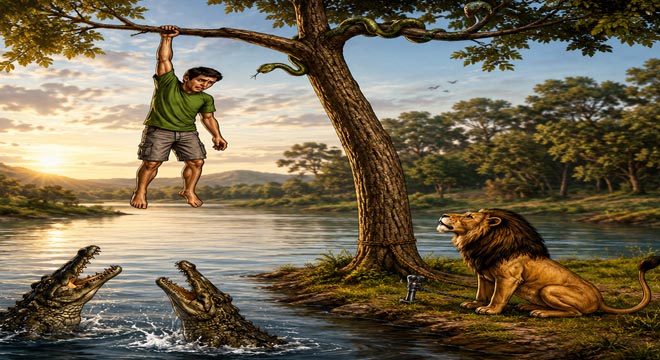
The man looks doomed. Predators circle. Every direction screams danger. Your pulse spikes because you know what you’d do—run, fight, climb, anything but stand there. Yet that instinct, the one you trust most, might be the very thing that destroys you. What if survival isn’t about strength or speed at all, but about what you refuse to do when your fear dema…
The man in the image isn’t just surrounded by animals; he’s surrounded by assumptions—ours. We assume he’s the center of their attention. We assume they’re all thinking about him, hunting him, closing in. But what if he’s only a bystander in their chaos? If their focus is elsewhere—on food, territory, rivalry—then his best move is not a frantic escape, but deliberate observation.
The real escape begins when he stops treating fear like a command and starts treating it like a signal to slow down, look closer, and wait for reality to reveal itself. Predators shift. Openings appear. What looked like a wall becomes a doorway when one threat turns on another or drifts away. He survives not by being the strongest, but by being the one person in the circle who refuses to panic before he can see the path that was there all along.