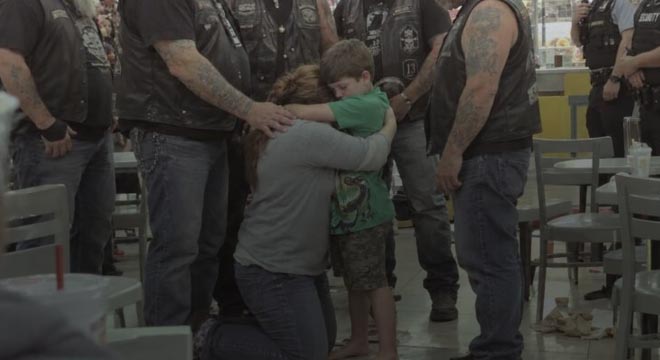
Six bikers in the food court heard me scream my son can’t talk and stood up at once.
I had been screaming for almost ten minutes by then. Not at them. At two mall security guards who kept telling me to calm down.
Owen is eight. He’s autistic and he doesn’t speak. He doesn’t understand cars or roads or why you can’t walk toward a sound you like.
And the sound he likes most in the world is trucks.
That mall backs right onto the highway. There’s a chain fence behind the loading docks with a gap in it that every kid in town knows about.
I turned around at the pretzel stand to pay. When I turned back his hand wasn’t in mine anymore.
I found the guards in two minutes and told them everything. Green dinosaur shirt, no shoes because he kicked them off in the car, can’t say his own name.
The younger one actually smiled. He said ma’am, kids wander off here all the time. They turn up at the toy store or the fountain, give it fifteen minutes.
Order Calendars
I said he doesn’t have fifteen minutes. I said he will walk straight onto that highway and he will not stop for a horn.
The older guard said he couldn’t call a Code Adam without his supervisor. His supervisor was on lunch.
That’s when I lost it. I screamed it across the whole food court. My son can’t talk and he’s going to die.
Every single person looked at me. Most of them looked away again.
Except the six men in leather at the corner table. They stood up like one person. Chairs scraped.
One of them, big, gray beard, maybe sixty, walked over and said show me his picture. Then he said what does he like.
I said trucks. He goes toward trucks.
He turned to the others and said loading dock, parking garage, the fence by the highway. Two each. Go.
They ran. Grown men in boots ran through a mall while the guards stood there holding their radios.
Eleven minutes later the gray beard’s phone rang. He put it on speaker.
A voice said I’ve got eyes on him. He’s standing on the shoulder of the northbound on-ramp. Barefoot. He’s about thirty feet off the lane and he’s just watching the trucks go by.
My knees went. The gray beard caught me under the arm without even looking at me. His name was Walt. I didn’t know that yet.
“Is he moving toward the road?” he said into the phone.
“No. He’s rocking. Every time a semi goes past he flaps his hands and kind of hops. He looks happy, man. He looks like he’s at a parade.”
Order Calendars
“Where are you?”
“Forty yards back, by the fence. I haven’t said a word to him.”
“Good. Don’t. Don’t call his name, don’t wave, don’t run at him. You stay right there and you watch him and that’s all you do. We’re coming.”
He hung up and looked at me for the first time since my phone rang.
“Can you run?”
I ran.
We went out through the back of the food court, past a door that said employees only, through a loading bay where a kid in an apron stared at us with his mouth open. Walt moved fast for a man his age. He didn’t jog. He ran, boots slamming on concrete, and I ran behind him in sandals that kept twisting under my feet.
The gap in the fence was exactly where I said it would be. Somebody had peeled the chain link back years ago and nobody ever fixed it. On the other side the ground dropped away through weeds and broken glass toward the sound I had been hearing in my nightmares for eight years.
The highway sounded like the ocean, if the ocean was made of engines.
Get Writing Tools
We have locks on every door at home, mounted up high where he can’t reach. An alarm on his bedroom window. A GPS tag sewn into the tongue of his left shoe, the same shoe that was sitting on the floor mat of my car in the parking garage, next to the right one.
Then I saw him.
Green dinosaur shirt. Bare white feet on gray gravel. His back to me, his face to the road, forty tons of steel going by at seventy miles an hour and my son was rocking on his heels like it was the best day of his life.
Every time a truck passed, his hands came up and fluttered beside his ears. That’s his happy. That’s what he does when the garbage truck comes on Tuesdays. I have a video of it on my phone that I’ve watched a thousand times.
I opened my mouth to scream his name and Walt’s hand clamped over it.
“If you yell, he’s gonna turn around to find you,” he said against my ear. “And when he turns, he’s gonna step. You don’t know which way. Do you understand me?”
Order Calendars
I nodded against his palm.
He let go and crouched down in the weeds next to me like we were watching a deer.
“What does he do when he’s calm? Not happy. Calm.”
“He hums,” I said. “He puts his ear on things that vibrate. The dryer. The car door. He hums with them.”
Walt looked at the road for a long second. Then he looked back along the fence line, where two of his people had just come through the gap. One was built like a refrigerator. The other was a woman with a gray braid down to her belt.
“Marcus,” Walt said. “Go get Tully’s bike. Walk it up the shoulder from behind the kid. Slow. Engine on. Don’t come at him, come past him on the fence side, like you’re just a guy with a bike. Rhonda, go stand in the lane.”
The woman didn’t blink. She walked straight down the embankment, stepped over the rumble strip and planted herself on the white line of the on-ramp with her arms out. The first car coming up the ramp hit the brakes so hard I heard the tires. She didn’t move. She pointed at the driver, then pointed at the ground, and the car stopped dead.
Then Pete was next to her. Then Sal. Three bikers in leather standing in the middle of an on-ramp with their backs to my son, and a line of cars stacking up behind them with nobody honking, because nobody could see what was going on and everybody could feel it.
“They can’t stop the highway,” I said.
“They don’t have to stop the highway,” Walt said. “They have to stop the ramp. Nothing’s getting on that road from here. Now watch.”
That’s when a semi on the main lanes saw him.
I heard the air horn before I understood it. Long and furious, the kind truckers lay on when something’s wrong. The driver had spotted a barefoot kid on the shoulder and did the only thing he knew how to do.
Owen’s whole body jerked. His hands flew up. And he took one step toward the sound.
One step. Toward the lane.
I made a noise I didn’t know I could make. Walt’s hand came down on my shoulder so hard it hurt.
Get Writing Tools
“Hold,” he said. “Hold. He stopped. Look at him. He stopped.”
He had. He was standing with one foot forward, swaying, head tilted, listening to the horn fade out down the highway. Twenty five feet from the white line. Twenty five feet became the whole world and I couldn’t look at anything else.
Then I heard the bike.
Marcus had Tully’s motorcycle in neutral, walking it along the gravel with one hand on the bar and the engine idling. It made a sound like a big animal breathing. Low and rough and steady.
Owen’s hands stopped.
He didn’t turn around. He went completely still, which is a thing he does when a sound he hasn’t heard before comes into the room. His whole body listens. His teacher calls it his antenna going up.
Marcus kept walking, kept the bike moving, past Owen on the fence side, not looking at him, not slowing down. When he was about fifteen feet ahead he stopped, let the bike settle, and stood there with his back to my son like he was waiting for a bus.
Owen turned around.
Away from the road. Toward the bike.
I had to bite the inside of my cheek to keep from making a sound.
He walked over with that little bounce in his step. He didn’t look at Marcus at all. He looked at the engine. He put both hands flat on the tank, then leaned forward and laid his cheek right down on the metal, and I heard him start to hum.
“Go,” Walt said. “Walk. Come up on the other side of the bike. Don’t grab him. Put your hand on the tank next to his.”
I don’t remember the walk. I remember the gravel. I remember Marcus not moving a muscle, this giant man standing like a fence post, and I remember kneeling on the far side of that motorcycle and putting my hand on the warm metal an inch from my son’s hand.
He opened his eyes. He looked at my hand. Then he slid his hand over until his pinky was touching mine, and he closed his eyes again and kept humming.
That’s how Owen says I’m here.
I put my forehead down on the tank and cried so hard I couldn’t breathe.
Somebody turned the engine off. I didn’t see who. When I looked up, Walt was standing over us, and the three from the ramp had come up the embankment, and six bikers stood in a loose circle around one motorcycle and one small barefoot boy and one woman who had completely come apart.
Nobody said anything. Rhonda handed me a bandana. It smelled like gasoline and I wiped my whole face with it.
“Thank you,” I said. It came out like a croak. “Thank you. I don’t even know your names.”
“Walt,” he said. “That’s Marcus. Rhonda. Pete. Sal. And the one who found him is Tully, he’s getting his bike back from Marcus before Marcus gets attached.”
Tully, the voice from the phone, was maybe thirty, skinny, with a small cross tattooed on his neck. He walked up the shoulder with his hands in his pockets.
“I almost called out to him,” he said to me. “When I first saw him. I had his name in my mouth. Then I thought about what Walt said and I shut up and I just watched him. Longest eleven minutes of my life.”
“How did you know?” I said to Walt. “How did you know not to yell. How did you know about the engine.”
He didn’t answer right away. He looked at Owen, who had sat down on the gravel now and was running his fingers along the exhaust pipe.
“Drove the special needs bus for the county for twenty two years,” he said. “Route 14. Had maybe forty kids like yours over that time. Nonverbal, runners, the whole range. You learn what works. You learn what gets a kid killed.”
Order Calendars
Then he said something I will never forget.
“You let go of his hand for one second. I’ve had parents let go for an hour. I’ve had parents let go for good. One second isn’t neglect, ma’am. One second is being a human being with two hands and a wallet. Don’t you carry this.”
I nodded. I didn’t believe him yet. I think I’m starting to now.
His father let go for good when Owen was four. He said he couldn’t do it anymore. The last thing he said to me on his way out the door was that I was turning Owen into a baby and that he’d be fine on his own, kids figure it out. I thought about that standing on the shoulder of I-80. Kids figure it out. Kids wander off. Everybody has a sentence that lets them walk away.
Getting Owen off that bike took forty minutes.
He would not leave it. Every time I tried to lift him his whole body went rigid and he started the high scream, the one that means I will hurt myself if you don’t stop.
So the bikers didn’t make him leave it.
They walked it. All six of them, pushing six motorcycles along the shoulder, up through the gap in the fence, across the loading bay and through the parking lot at the speed of an eight-year-old who had one hand on Tully’s handlebar and was humming the whole way. Tully walked on the other side with his hand on the bar too, matching Owen step for step, never once looking down at him.
A semi on the frontage road slowed down beside us. The driver leaned out his window and asked if that was the boy. Rhonda said yeah. He said he was the one who called it in, and he’d been praying the whole way down the ramp. Then he pulled his horn cord twice, soft, and Owen’s hands came up and fluttered.
People in cars stared. A woman filmed it. I don’t care. I have never been part of a more beautiful parade.
Mall security was waiting at the edge of the lot.
Both guards, and a third man in a shirt and tie with a lanyard, who I found out later was the supervisor. The one who’d been at lunch.
The first thing he said was not “is he okay.”
The first thing he said was that the loading bay was a restricted area, that they’d had reports of unauthorized individuals running through the building, and that he was going to need everyone’s names.
Walt stopped his bike. The whole line stopped behind him.
“My name’s Walt Henning,” he said. “I was in your food court when this woman told your two guards that her nonverbal son was headed for the highway, and your guard told her to give it fifteen minutes. I was there when she asked for a Code Adam and your other guard said he couldn’t call one without you. And you were at lunch.”
The supervisor started to say something about protocol.
“Your protocol put an eight-year-old on the shoulder of I-80,” Walt said. He didn’t raise his voice. “Write that down next to my name.”
The younger guard, the one who had smiled at me, had gone the color of paper. He was looking at Owen’s bare feet. I watched him look at the feet, then toward the highway you could still hear from where we stood, then at the ground.
A state trooper pulled in about then. Somebody on the ramp had called it in, a kid on the shoulder, bikers blocking traffic. He took one look at six motorcycles and put his hand on his belt.
Then Rhonda walked over and told him what happened in about thirty seconds, and he took his hand off his belt and got out his notebook.
He asked me if I wanted to make a statement about the mall’s response. I said yes. The supervisor said the mall would be conducting its own internal review. The trooper said that was fine, he’d be conducting his too, and that his report would say the child was recovered by six private citizens and not by mall security, and that mall security had declined to initiate a Code Adam when the parent requested one.
The supervisor stopped talking after that.
Here’s the part I didn’t expect.
Walt gave me his number before they left. He wrote it on the back of a gas receipt and told me that if I ever brought Owen back to that mall, I should call him first, and he and whoever was around would come eat lunch at that corner table.
I thought it was a nice thing to say. The kind of thing people say.
Three Saturdays later I called it. Half because I had to buy Owen new shoes and half because I needed to prove to myself I could walk into that building again.
They were already at the table when we got there. Four of them that day. Walt, Rhonda, Tully, and a man I hadn’t met named Deacon. Owen walked straight past the pretzel stand without even slowing down, went to the table, and climbed onto the chair next to Walt like it had his name on it.
He doesn’t do that. He doesn’t go to people. He has never in his life walked up to anyone who wasn’t me or his grandmother and sat down.
Walt didn’t make a thing of it. He pushed his fries to the middle of the table and went on talking to Deacon about a carburetor.
Owen ate eleven of his fries. I counted.
I bought him shoes with Velcro straps that day. I sewed the GPS tag into his sock this time.
Order Calendars
The young guard found me by the shoe store an hour later. Brandon, his name tag said. He stood there a while before he said anything.
He told me they’d written him up. He told me he deserved it. He told me he’d gone home that night and looked up what nonverbal meant, and then what elopement meant, and then he’d found a video of a kid on a highway in Texas, and he hadn’t slept.
“I thought he was just a kid who wandered off,” he said. “I didn’t know there was a kind of kid who can’t wander back.”
“Now you know,” I said.
“Now I know.”
He told me the mall had changed the rule. Any employee can call a Code Adam now, no supervisor needed. He said he’d pushed for it. I don’t know if that’s true. I decided to believe him.
The last thing I’ll tell you is about Walt.
The day of the parade, when Owen finally let go of the handlebar in the parking lot, I asked Walt one more time how he knew. Not about the engine. About the running. Why six grown adults ran through a mall for a kid they had never seen.
He was quiet for a long time.
“1998,” he said. “Boy on my route named Danny. Nine years old. Nonverbal, loved water, would walk into anything blue. Family took him camping at a lake and he got out of the tent at five in the morning.”
He looked at his boots.
“Took the campground forty minutes to start looking. Everybody figured he’d turn up. Kids wander off.”
He didn’t say the rest. He didn’t need to.
“I told myself that day that if I ever heard a mother scream like that again, I wasn’t going to figure anything. I was going to stand up.”
Track Pregnancy
Owen draws trucks. That’s mostly what he draws. Hundreds of them, in crayon, the same green crayon worn down to nothing.
Two weeks after the mall, he drew a motorcycle. Then he drew six. Six motorcycles in a line with little round men on them, and one with a long braid, and in front of the first one a stick figure with yellow hair, which is me, and a smaller stick figure with no shoes.
I gave it to Walt at the food court. He looked at it for a long time, then folded it very carefully and put it inside his vest.
Rhonda told me later it’s taped inside the windshield of his bike now. She said in forty years of riding, it’s the only decoration he’s ever allowed on that motorcycle.
Six bikers stood up at once.
Order Calendars
Every other person in that food court looked at me, and then looked away. I think about that every single day.
And then I think about the six who didn’t.