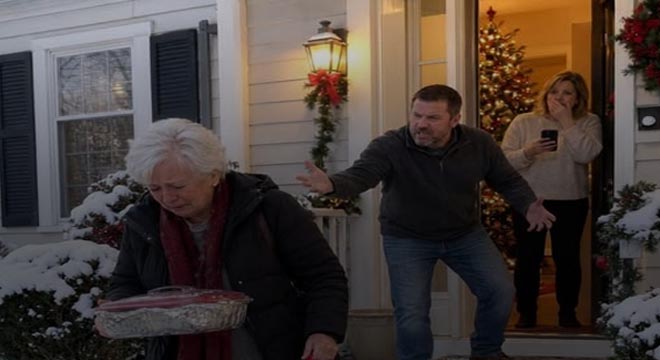
“Wrong house,” my son called over his shoulder when his little boy asked who was at the front door. Snow was falling onto my gray wool coat, and the covered turkey in my arms had begun to grow heavy. Behind Daniel, I could see a Christmas tree blazing with white lights, guests holding champagne glasses, and a dining table set with fourteen places. I’d driven twenty minutes through the cold with gifts for my grandchildren, just as I’d done every Christmas Eve since my husband died. “Please leave, Mom,” Daniel whispered, keeping his body between me and the warmth of the hallway. “Don’t make this embarrassing.” Then he closed the door, and I stood on the icy porch listening to music and laughter resume inside, wondering how my own son had come to describe me as a stranger. By Christmas morning, he would have called me twenty-five times, but not because he’d suddenly remembered the turkey or the woman he’d left standing in the snow.
My name is Margaret Whitmore. I’m sixty-eight years old, a retired school nurse who spent thirty-one years at Jefferson Elementary in Livingston, New Jersey, and I was married to Richard for thirty-four years before a heart attack took him in the parking lot of his hardware store. We lived carefully, saved what we could, and raised one son, Daniel, who inherited his father’s smile and, I once believed, his habit of taking responsibility for the people he loved. Christmas had always been the center of our family calendar. Richard carved the turkey, I made the gravy, and Daniel stole pieces of crispy skin when he thought nobody was watching. After Richard died, I continued spending Christmas Eve with Daniel, his wife Claire, and their children, Sophie and Owen. The arrangement was so familiar that nobody usually issued an invitation. But that year Daniel had been strangely evasive, telling me he’d confirm the time and never calling back. I assumed he’d forgotten in the rush of holiday preparations, so I roasted the turkey, wrapped a blue sweater for six-year-old Owen, bought a snow globe for nine-year-old Sophie, and drove from my modest ranch house in West Orange to Daniel’s large colonial in Maplewood. When I arrived, unfamiliar cars lined the street, including the silver Mercedes belonging to Claire’s parents, Gordon and Patricia Hollister. Through the front window, I could see relatives, business acquaintances, and children in matching pajamas. Daniel explained at the door that the party was for Claire’s family and several important guests from Gordon’s law firm. He didn’t want me joining them. When Owen called out to ask who had arrived, Daniel told him it was the wrong house, and I left without speaking to either grandchild. At home, I set the turkey and gifts on the kitchen counter and sat in the dark, trying to understand what I’d done to deserve such treatment. At 10:47 that night, my telephone rang. I answered eagerly, hoping for an apology, but heard laughter and the clinking of glasses behind Daniel’s voice. Claire was joking about the turkey I’d brought, and someone else laughed as Daniel, sounding as though he’d been drinking, told me not to make a fuss the following day. Then Claire said something that stayed with me: “Money can’t buy her a spot here.” Daniel repeated it before ending the call. I knew immediately that they were talking about financial help I’d provided for years, although I’d never used that help to demand anything in return. Fourteen years earlier, Daniel’s landscape-design business had collapsed after a partner emptied its bank account. Claire was pregnant with Sophie, and the couple faced unpaid suppliers, mounting debts, and the possibility of losing their apartment. Richard had been dead two years, and I’d sold his hardware store, leaving me with life-insurance proceeds and the savings we’d accumulated over a lifetime. I paid Daniel’s business creditors and helped him make a down payment on a starter house in Union. He cried at my kitchen table and promised he’d never forget what I’d done. But the emergencies didn’t stop. When they moved to a larger home in Maplewood, I began contributing $2,100 a month toward their mortgage. When Sophie enrolled at a private academy in Short Hills, I added tuition payments of approximately $3,400 a month. Daniel started a consulting business, and I supplied another $1,500 monthly to keep it operating. I paid portions of their automobile insurance, contributed to a new roof, helped with dental bills and summer camps, and opened a separate account I called the Family Fund so Daniel could draw money when unexpected expenses arose. He drew from it frequently. I never asked for a complete accounting because I believed a mother’s role was to help her child through difficult years, and I assumed the assistance would end when he became financially secure. Meanwhile, the roof over my own back bedroom leaked for three winters, my fourteen-year-old Corolla needed constant repairs, and I postponed cataract surgery because the cost worried me. My neighbor Ruth Abramowitz invited me every spring on a bus trip to see the tulips in Holland, Michigan, and every year I declined. I told myself those things could wait until Daniel’s family was comfortable. That Christmas Eve, after listening to my son tell me money couldn’t buy a place at his table, I opened the bank statements I’d been avoiding and added up fourteen years of transfers. The total was $412,000, more than half the money Richard and I had saved. I stared at the figure for a long time before opening my online banking account and canceling the recurring transfers for the mortgage, tuition, business support, insurance, and Family Fund. I arranged to return the remaining balance of the fund to my own savings and remove Daniel’s access. Just after midnight, I closed my
laptop and went to bed, frightened by what I’d done but certain I could no longer continue financing a life in which my presence was considered embarrassing.
On Christmas morning, I woke to twenty-five missed calls from Daniel and a string of increasingly desperate messages. His mortgage payment had been rejected, the private school had notified him about a failed tuition transfer, and a business card had been declined at a gas station. In a voicemail, he explained that Claire’s parents were still staying at the house and begged me to restore the payments before anyone discovered the extent of their financial dependence. He blamed the previous night’s remarks on alcohol and pressure, but didn’t directly apologize for leaving me outside in the snow or telling his children I was a stranger. I listened once, then put the phone aside. Around ten, Ruth knocked on my back door carrying a plate of rugelach and wearing a sweatshirt with a joke about unnecessary meetings printed across the front. She’d lived next door for twenty-three years, was a retired court stenographer, and had become one of my closest friends after we were both widowed. When I told her what had happened, she listened without interrupting, then asked why I’d spent so much money supporting Daniel while neglecting repairs and medical care in my own home. I began to cry, partly from grief and partly because I could finally hear how unreasonable the arrangement sounded when I described it aloud. Ruth held me until I could speak again, then invited me to spend Christmas Day with her family. We reheated my turkey, served it with sweet potato kugel, and ate at her small table beneath a cheerful plastic tablecloth decorated with reindeer. Her nephew Benjy and his wife arrived with their baby, and the afternoon passed in conversation, laughter, and the comfortable disorder of a family meal. It was not the Christmas I’d planned, but I was welcome there without having to provide anything beyond the food I’d already prepared. Daniel came to my house on December 26, looking exhausted and angry. He explained that the school wanted tuition before the new term, that the mortgage had incurred fees, and that his consulting business had only $1,100 left despite having two employees to pay. When I asked why he’d excluded me from Christmas Eve, he eventually admitted that Gordon had invited senior partners from his firm, including a developer named Warren Pike, who was considering a valuable project-management contract. Gordon believed Daniel was a successful, self-made businessman, and Daniel had never corrected him. He feared I might casually mention the mortgage or tuition during dinner and reveal that his lifestyle depended on his mother’s money. Claire knew the truth and resented the support because it made her feel ashamed before her wealthy parents. Daniel had hidden me not because of my appearance or age, but because I was the person most likely to expose a financial reality he’d spent years concealing. He asked me to resume the transfers, at least for the children’s schooling. I refused to reopen the arrangement without considering a more responsible way to help Sophie and Owen, and he left disappointed. The following day, Claire sent an angry message accusing me of using money to control their family and threatening the children’s education. I didn’t reply. Instead, Ruth recommended a financial planner named Priya Desai, whose office was above a dry cleaner in Livingston. Priya reviewed my statements, retirement income, remaining savings, and the costs I’d deferred on my house and health. She estimated that if I continued supporting Daniel at the same rate for another five years, I could exhaust my savings and leave myself dependent on a modest pension and Social Security while facing major home repairs. Hearing that frightened me more than the angry messages. Together, we prepared a new financial plan that protected my own needs while providing a limited, transparent way to assist the grandchildren. I would no longer pay Daniel’s mortgage, finance his company, or cover the family’s cars and household expenses. Instead, I would fund education accounts for Sophie and Owen, with appropriate restrictions and payments directed toward legitimate educational expenses rather than transferred into their parents’ accounts. If private-school tuition remained necessary and affordable, I would consider paying the school directly for a defined period. That evening, Sophie telephoned me from an old phone she used for games. She whispered that she’d recognized me on Christmas Eve through the window, despite her father’s claim that nobody familiar had been at the door. She was frightened because her parents were arguing and Gordon had discovered the financial situation. I reassured her that the disagreement was between adults, that she and Owen were not responsible, and that I loved them regardless of where they lived or attended school. She asked about the gift bag I’d carried, and I told her Owen’s blue sweater was safe in my closet, along with her snow globe. When she apologized for her father’s words, I reminded her that she’d done nothing wrong. She had simply recognized her grandmother. That conversation reminded me why I needed boundaries that protected the children without continuing to conceal the adults’ financial problems. On New Year’s Eve, Daniel returned, this time driving Claire’s small Honda because they’d surrendered the lease on their expensive SUV. Gordon had learned the truth after the bank contacted the household about the mortgage, and he’d demanded to examine the business records. Daniel confessed that Whitmore Consulting had been losing money for six years and that he’d concealed the losses by relying on my monthly payments, hoping one major contract would eventually solve everything. Gordon was disappointed not because Daniel had struggled, but because he’d lied about his success while allowing his widowed mother to finance the illusion. Claire had been forced to confront her own part in the deception. She waited nervously in the car until I invited her inside, where she apologized for laughing at me on Christmas Eve and for treating my generosity as something humiliating. She admitted that she’d been relieved when Daniel closed the door because she feared her parents would discover the truth. I told her I couldn’t forget the cruelty of that night simply because she was ashamed of it now, but I was willing to begin rebuilding trust if their behavior changed. Then I showed them my new financial arrangements and made clear that their mortgage and business obligations belonged to them. They sat together at my kitchen table, looking at figures that could no longer be disguised. Claire finally said what neither had wanted to acknowledge: they would have to sell the Maplewood house, move somewhere affordable, and reconsider their children’s schooling. Daniel would need to close his failing company and find steady employment. He put his face in his hands, just as he’d done fourteen years earlier when he first asked me for help. This time, I stayed in my chair and let him work through the consequences without reaching for my checkbook.
The next six months were difficult for Daniel and Claire, but they began making decisions based on what they could actually afford. Daniel closed Whitmore Consulting in February and worked with his accountant to settle outstanding obligations, including final wages for his two employees. He spent weeks applying for jobs, receiving rejections, and learning that his professional experience was more valuable than the image he’d maintained. In April, he accepted a project-management position with a commercial construction company in Newark. The salary was considerably lower than the income he’d claimed to earn, but it came with benefits and the stability of regular pay. He called me after accepting the offer and admitted that he was nervous about reporting to a supervisor after years of describing himself as a business owner. I told him his father would have been proud to see him take responsibility for his work. The Maplewood house went on the market in March and sold in May. Daniel and Claire moved into a rented three-bedroom home in South Orange, where the children shared a bathroom and Claire took a job handling billing at a dental office four days a week. Sophie transferred to a public-school program and, after an unhappy fortnight, joined the robotics club and made friends with a girl named Imani who also collected snow globes. Owen cared far less about the move than anyone expected; he wanted a playground and a school cafeteria with decent tater tots. The family’s circumstances were simpler, and though there were hard adjustments, Daniel stopped asking me to rescue him from them. When Claire’s car needed a major transmission repair, they arranged a payment plan with the mechanic and told me afterward rather than seeking money in advance. Our telephone conversations gradually changed. Daniel called to tell me about construction sites, colleagues, difficult schedules, and small victories at work. He sounded tired, sometimes frustrated, but more at ease than he’d been in years. Meanwhile, I finally attended to the needs I’d been postponing. I hired a roofer named Hector, who discovered serious rot beneath the leaking section of my roof and warned that another winter could have caused extensive damage. I underwent cataract surgery in June, and the morning after the procedure, I stood at my kitchen window astonished by how clearly I could see the leaves on the maple tree across the street. I hadn’t realized how much my vision had deteriorated because the changes had come gradually, just as my financial sacrifices had. In May, Ruth and I finally took the bus trip to Holland, Michigan, where we walked among fields of bright red, yellow, and purple tulips stretching toward the horizon. She teased me about taking so long to accept her invitation, and I laughed because there was nothing left to argue about. For the first time since Richard died, I was spending some of our savings on the life we’d intended me to enjoy. That autumn, Daniel called one Sunday evening and spoke about Christmas Eve without making excuses. He said he often remembered me standing on the porch with the turkey and Owen asking who was at the door. He had told his son I was a stranger because he was ashamed of needing me, and he acknowledged that the decision had been cowardly and cruel. He apologized directly, without mentioning alcohol, social pressure, or what Claire’s family might have thought. I thanked him because that was what I’d needed to hear. When he asked whether I would come for Christmas Eve that year, I said I would think about it. A week later, a real invitation arrived in the mail, decorated with a glittery Christmas tree. Owen had written in his uneven childhood handwriting that Grandma was invited at six o’clock and should please bring the turkey. Beneath it, Daniel had added that they had a place set for me. I put the card on my refrigerator beneath a tulip-shaped magnet from Michigan. On Christmas Eve, I roasted another turkey, strapped the covered dish into the passenger seat of my old Corolla, and placed the same red gift bag beside it. The blue sweater still fit Owen, thanks to my habit of buying children’s clothes a little large, and I’d found Sophie a new snow globe with a tiny red house inside. Daniel and Claire’s rented home was smaller than the Maplewood colonial, with white siding, a green front door, and a slightly crooked Christmas tree visible through the window. I parked at the curb and sat for a moment, remembering the cold porch from the year before. Then Daniel came outside without a coat, walked down to the car, and took the turkey from me. He waited while I stepped onto the icy sidewalk and offered his arm as we approached the door together. Owen rushed onto the porch in his socks, threw his arms around my waist, and announced that Grandma had come to the right house. Inside, Sophie hugged me, Claire welcomed me warmly, and Gordon Hollister crossed the living room to apologize for not noticing how I’d been treated. The dining table was made from two smaller tables pushed together beneath a plastic tablecloth, surrounded by mismatched chairs. There was no elaborate display of wealth and no attempt to impress anyone. At the head of the table, Sophie had placed a handwritten card bearing a single word: “Grandma.” Daniel handed me Richard’s old carving knife and asked me to carve the turkey, explaining that he’d forgotten how much those family traditions had mattered. I looked around at the children, at Claire and her parents, and at my son standing beside me. Then I began carving. A moment later, Owen reached across the table and stole a piece of crispy turkey skin when he thought nobody was looking. Daniel saw him and glanced at me. Neither of us said a word, and for an instant I could almost hear Richard laughing.
I drove home that night beneath a clear winter sky, passing quiet streets dusted with snow. The house was warm when I entered, the repaired roof was sound, and I could see the glitter from Owen’s invitation sparkling on my kitchen counter beneath the refrigerator light. I made a cup of tea and thought about how differently the previous Christmas had ended, with me sitting in the dark wondering whether I had become an embarrassment to my own child. For fourteen years, I’d believed helping Daniel meant making sure he never had to face the full weight of his financial problems. I did it willingly, but I hadn’t recognized how much that arrangement was costing both of us. It left me with a leaking roof, postponed medical care, and savings that were disappearing faster than I could replace them. It also allowed Daniel to avoid confronting the fact that his business and his family’s lifestyle were beyond what he could support. When I stopped the payments, it felt at first as though I was abandoning him. Watching him find work, sell the house, and begin managing his own obligations showed me that the support he’d needed was not another emergency transfer. It was the chance to rebuild his life without pretending that someone else would always cover the difference. That realization didn’t erase what happened on the porch. I still remembered Daniel’s words, Claire’s laughter, and the cold weight of the turkey in my arms. I also remembered Sophie’s phone call, Ruth’s kitchen table, and the kindness that helped me feel less alone during a holiday I’d expected to spend with family. Those memories mattered because they taught me to notice the people who made room for me without asking what I could provide. My relationship with Daniel was warmer now, although not because everything had returned to the way it once was. We talked about his work, the children, and the ordinary details of life. I enjoyed listening to him describe a difficult day on the construction site or a project he’d completed successfully, especially knowing he no longer needed to turn every conversation into a request for help. Claire and I were more cautious with each other, but she made an effort to include me, and I appreciated the small changes that gradually rebuilt trust. Sophie still called to tell me about school, and Owen sometimes asked whether I could make turkey on an ordinary Sunday because he didn’t see why we should wait for Christmas. I continued contributing to the children’s education through the arrangements Priya had helped establish, and I kept my own financial needs firmly in view. Ruth and I had already begun discussing another short trip, perhaps somewhere with gardens or a museum she’d been wanting to visit. My eyesight was better, my home was safer, and I had begun enjoying retirement in ways Richard and I once imagined together. I knew he would have wanted me to help Daniel when he was struggling, but I also believed he’d have wanted our son to become capable of supporting his own household. One evening, while sorting old photographs, I found a picture of Daniel at seven years old, standing beside Richard in our kitchen with flour on his cheek. They’d been making Christmas cookies, and Richard was holding a wooden spoon like a conductor’s baton while Daniel laughed. I sat with the photograph for a long time, remembering how much joy there had been in our family before money and appearances became tangled together. I didn’t want to return to those years or pretend they had been perfect. I wanted to carry forward what had been good about them: the crowded table, the shared food, the willingness to help one another, and the understanding that family members should never have to disguise who they are to be welcomed. My phone buzzed beside the photograph. It was a message from Daniel thanking me for coming and asking whether I’d bring the turkey again the following Christmas. I looked at the invitation still hanging on the refrigerator and smiled. Then I typed back that I would, and that this time I’d expect someone else to make the gravy.