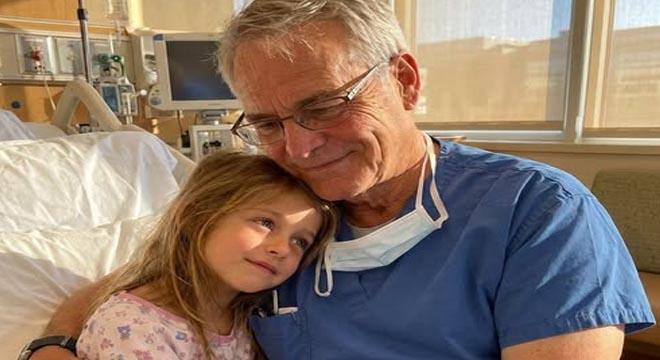
“Dr. Miller, there’s something you need to see,” the stranger said, standing on my front porch with a leather folder tucked beneath his arm. A black sedan waited at the curb, and the morning air was cool enough that I pulled my robe tighter around my shoulders. I’d barely recovered from thirteen exhausting hours of emergency surgery on a five-year-old girl who had nearly died in a terrible car accident, and my first thought was that something had gone wrong overnight. “Is Sophie all right?” I asked, suddenly afraid that all our efforts to save her had been in vain. The man assured me she was stable, then opened his folder just far enough to reveal a photograph of a young woman standing outside a brick building. Something about her smile made my chest tighten, although I couldn’t immediately understand why. When I asked who she was, he said the answer involved my daughter, Emily, who had died three years earlier, and that someone wanted me to hear a story I had never been told. I stood there staring at the photograph, wondering how a stranger at my door could know anything about the child I’d buried, before reaching for my coat and asking him to explain where we were going.
My name is Dr. Robert Miller, and at sixty-five, I’d spent almost thirty-five years working as an emergency and trauma surgeon. It was a demanding profession, one that had given me immense satisfaction but had also taken a considerable share of my life. I’d missed anniversaries, birthdays, Sunday dinners, and school events because somebody needed emergency surgery and there was no time to find another doctor. My wife, Milly, had understood the work better than most people, although she occasionally reminded me that the hospital would still be standing if I took a weekend off. She died several years before our daughter, leaving Emily and my granddaughter Lucy as the center of my life outside medicine. Then, three years ago, a car accident took both of them. Emily had been a loving mother, a thoughtful daughter, and the kind of woman who remembered birthdays and called friends simply to ask how they were doing. Lucy was seven, endlessly curious, and convinced that her grandfather could repair anything from a broken toy to a scraped knee. Losing them left me with a house full of photographs and an unbearable absence where ordinary
family life had once been. After the funeral, I began accepting additional shifts. I told colleagues the emergency department was short-staffed and that younger surgeons needed experienced support, both of which were true. What I rarely admitted was that I dreaded going home. There were no longer any little
shoes by the door, no hurried telephone calls from Emily asking whether I could collect Lucy from school, and no one waiting to hear about my day. My colleague Paul noticed how little time I spent away from the hospital. “Robert, you’ve given enough of your life to this place,” he told me more than once. “You ought to think about retirement.” I knew he was right about my aching knees, the headaches after overnight shifts, and the fatigue I could no longer dismiss as temporary. But retirement meant long afternoons in a silent house, and I wasn’t sure I could bear them. Then, just before midnight on a particularly difficult shift, an ambulance brought in five-year-old Sophie. She had been involved in a severe collision that killed the two adults traveling with her. Her blood pressure was dangerously low, her pulse was weak, and the paramedics had already begun emergency resuscitation. When I saw her brown curls, I thought of Lucy so suddenly that I had to steady myself. Paul noticed my expression and quietly asked whether I was all right. I told him I was ready, and we went to work. Sophie’s injuries required urgent surgery, blood transfusions, and continuous monitoring as our team worked to control bleeding and stabilize her circulation. Several times, her condition became critical. At one point, I stepped aside briefly while another surgeon continued the procedure, took a drink of water, and forced myself to concentrate on the patient before me rather than the memories her face had awakened. The surgeons, anesthesiologists, nurses, and intensive care staff worked together through the night and into the following day. Approximately thirteen hours passed between Sophie’s arrival and the completion of the most urgent interventions. When we finally transferred her to intensive care, she was still critically ill, but she had survived. Outside the operating area, a young woman hurried toward me and introduced herself as Gianna, Sophie’s mother. She was distraught and desperate to know whether her daughter would live. I explained that the surgery had been successful in addressing the immediate threats to Sophie’s life, although her recovery remained uncertain and she would need close observation. Gianna covered her mouth and began crying. Then she embraced me so suddenly that I barely had time to respond. “You have no idea what you’ve done for me,” she whispered. I assured her that an entire medical team had cared for Sophie and that we would continue doing everything possible. When I introduced myself as Dr. Miller, she stepped back and asked for my first name. “Robert,” I replied. Her expression changed, and for a moment she stared at me as though she’d recognized someone she had been searching for. Before I could ask why, a nurse approached with an update about Sophie, and Gianna hurried away. I went home later that day and slept for hours, unaware that her reaction had an explanation connected to the daughter I’d lost.
The stranger on my doorstep introduced himself as Sebastian, the director of a nearby family support organization. When I asked how he’d obtained my address, he explained that Emily had volunteered there and that I had sent the organization a memorial donation after her death. He remembered my name from its records and had come at Gianna’s request. I was surprised because Emily had mentioned volunteering with young families, but she’d never described the organization in great detail. Sebastian told me the center was only fifteen minutes away and that Gianna wanted me to see something before she explained the connection. I agreed to accompany him, partly because I was curious and partly because hearing someone speak about Emily without the hushed awkwardness that usually accompanied her name felt unexpectedly comforting. During the drive, Sebastian asked whether I’d eaten breakfast. When I admitted I hadn’t, he smiled and said Emily would have scolded me. She had frequently reminded me that a surgeon couldn’t live indefinitely on coffee and whatever food happened to be available in the hospital cafeteria. The remark brought back her voice so clearly that I looked out the window for a moment. We arrived at a modest brick building with a blue entrance, a reception desk, several small offices, and a cheerful room filled with children’s books and toys. Along one hallway hung photographs of volunteers and families who had participated in the center’s programs. In the middle of a group photograph stood Emily, smiling broadly with her arm around a much younger woman. I stopped walking. I’d never seen the picture before. Sebastian explained that my daughter had helped develop the center’s support program for teenage parents, assisting young mothers who needed stable housing, educational guidance, childcare resources, and practical encouragement. Then he led me into an office where Gianna was waiting. She stood when I entered, thanked me again for helping Sophie, and asked me to sit down. Six years earlier, she explained, she had been seventeen, pregnant, frightened, and facing the prospect of leaving school. Her parents weren’t prepared to support her, and she had nowhere dependable to live. Someone directed her to the center, where Emily spent nearly three hours listening to her worries and helping her identify what she needed. Gianna remembered repeatedly apologizing for taking up so much of Emily’s time. My daughter had answered, “People aren’t a waste of time.” Those words sounded so much like Emily that I felt my throat close. Gianna described how Emily helped her arrange temporary accommodation, enroll in a program that allowed her to complete her education, and apply for childcare assistance after the baby arrived. When Gianna went into labor, Emily stayed with her through the birth because she was frightened and didn’t want to be alone. Then Gianna placed a photograph on the desk. It showed Emily in a hospital room holding a newborn baby wrapped in a pale blanket. “That’s Sophie,” she said quietly. I stared at the image, scarcely able to comprehend that the child whose life we’d fought to save had once been cradled in my daughter’s arms. Gianna explained that Emily had been the first person outside her family to hold Sophie, and that she continued checking on them afterward. She also told me something I hadn’t expected: Emily had spoken about me often. She described her father as a surgeon who helped strangers during the worst moments of their lives, someone whose work had taught her that helping people wasn’t always convenient but was still worth doing. I remembered saying something similar to Emily when she was a teenager, during an argument about a birthday dinner I’d missed because of an emergency operation. I’d spent years regretting those missed occasions, convinced that my daughter remembered only how often work had taken me away. Hearing that she’d admired the same work that sometimes frustrated her made me cry. Gianna produced another photograph showing Emily and Lucy sitting on the floor among piles of children’s books. I recognized the occasion as soon as I looked closely. Lucy had once told me she’d spent an afternoon sorting books into categories because some children preferred animals and others liked princesses. She’d proudly assured me she’d made a separate pile for dinosaurs. I hadn’t known the activity had taken place at the center or that she and Emily had been preparing donated supplies for Gianna and Sophie. Gianna explained that she’d wanted to contact me after Emily and Lucy died but had been afraid of reopening my grief. When she heard my name at the hospital, she recognized it immediately and contacted Sebastian. Then she reached into her bag and placed a sealed envelope before me. My name was written across the front in Emily’s unmistakable handwriting. Gianna explained that Emily had left it with Sebastian while planning an expansion of the center’s family rooms, intending for him to give it to me when the project opened. The expansion had been delayed after her death and had only recently been completed. My hands shook as I unfolded the letter. Emily had written that although she sometimes complained about my long hours, she wanted me to know how proud she was of me. She said I’d taught her that saving someone’s life didn’t always happen inside an operating room; sometimes it meant listening to a frightened person, finding them a safe place to sleep, or helping them believe they had a future. At the bottom, she had added an invitation for me to volunteer at the center when I retired. I laughed through my tears, recognizing my daughter’s determination to recruit me into another demanding commitment. Gianna took my hand and said, “Your daughter helped Sophie have a future before she was born, Dr. Miller. Yesterday, you helped make sure she still has one.” For three years, I’d thought there was nothing left of Emily’s life that I hadn’t already lost; sitting in that little office, I began to understand how much of her kindness was still present in the lives of people I’d never met.
Plan Family Trips