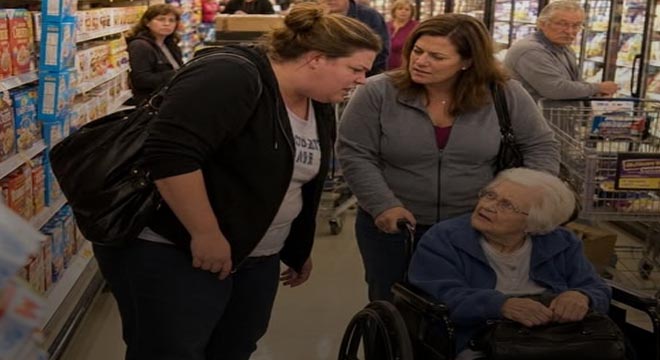
“Stand up and prove you need that wheelchair!” The woman’s voice cut across the second floor of Halbrook’s Department Store, turning heads at the checkout counters and silencing a cashier in the middle of a transaction. She wore a tan raincoat and carried a shopping basket containing expensive olives and scented candles, and she’d been following my eighty-year-old mother and me for nearly ten minutes. My mother sat quietly in her wheelchair, folding a pale-blue silk scarf she’d decided not to purchase, while the stranger insisted that anyone who could reach for merchandise on a high shelf must be capable of walking. Before I could respond, the woman stepped forward and kicked the back of Mom’s wheelchair so hard that its front wheels lifted momentarily from the tile floor. I lunged toward the chair, terrified my mother would fall, and demanded that the woman never touch her again. A security guard hurried toward us as the stranger challenged him to make Mom stand, certain she’d exposed a fraud. Instead, Mom calmly reached into the pocket of her gray cardigan and removed the worn leather case containing her medical information. When a folded school-concert program slipped from the case and landed at my feet, I recognized the faded purple circle around my daughter’s name—and felt the familiar weight of a secret I’d carried since the accident that left my mother unable to walk six years earlier.
My name is Rebecca Callahan, and my daughter, Mia, was about to turn twelve. My husband, Sam, and I had taken my mother shopping that October morning because she wanted to choose Mia’s birthday gift herself. Mom had been a music teacher for thirty-four years at Lincoln Middle School, where she taught choir, band, and general music to thousands of students. She could tune a piano by ear, hear a wrong note from the far side of an auditorium, and remember the names of children she’d taught decades before. At eighty, she remained sharp, funny, and fiercely independent, despite the spinal cord injury that had changed her mobility. She hadn’t walked in six years, but she could maneuver her manual wheelchair with considerable skill and preferred making decisions without someone hovering over her. I hovered anyway. From the moment we entered Halbrook’s, I’d suggested shopping areas near the elevator, offered to steer her toward easier displays, and reached for her chair handles each time she moved independently. She reminded me repeatedly that she could find her own way. I heard the words, but I rarely changed my behavior. Six years earlier, I’d watched paramedics remove her from the crushed driver’s side of her little blue sedan at the intersection of Fifth and Garland. A nineteen-year-old pickup driver had run a red light while distracted by his phone, striking her car at approximately forty-three miles per hour. She suffered a serious spinal injury involving her tenth thoracic vertebra. After emergency surgery, nine days in intensive care, and months of rehabilitation, her medical team explained that she was unlikely to regain functional walking ability. She was seventy-four at the time. Before the collision, she had lived in the house where I grew up, tended a garden of roses, played piano while standing beside the bench, and driven herself wherever she wanted. Afterward, I helped move her into an accessible ground-floor apartment nearer my home. I arranged the installation of grab bars and other modifications, organized her medications, coordinated groceries, and monitored her appointments. Some of those changes were necessary, but I gradually began managing things she was perfectly capable of doing herself. I telephoned every evening at nine to ask whether she’d taken her medicine, locked the door, and charged her phone. I also persuaded her to allow a camera in her living room, claiming it would help me know if she fell. She never openly argued, but I noticed that a dish towel often appeared over the lens. My husband gently suggested I was exhausting both of us. He reminded me that Mom taught piano lessons, attended church, practiced physical therapy, and had supportive neighbors, including her friend Doris. I refused to discuss it. To me, constant vigilance felt like the only responsible response to what had happened. I couldn’t bear the thought of another accident. The truth was more complicated: I believed I had played a part in the first one. The morning Mom was struck, Mia had been preparing for her spring concert at Maplewood Elementary School. She was six and had practiced her two songs for weeks, singing them in the bath, at the breakfast table, and during every car ride. Three days before the performance, she’d proudly brought Grandma a copy of the printed program, circling her own name in purple so Mom could locate her among the first-grade singers. Mom promised to keep the program safe and look for the purple circle. On the morning of the concert, she called me at seven thirty. She had a terrible headache, hadn’t slept well, and thought she should stay home. Instead of accepting that, I pleaded with her to attend. I reminded her how much Mia wanted her there, suggested the visit would take only a few minutes, and told her how disappointed our daughter would be if Grandma missed her first school performance. Mom repeatedly said she was tired, but I continued asking until she agreed. I hung up feeling relieved, even pleased with myself for persuading her. At 9:41 that morning, while I sat in the school auditorium saving her a seat, the pickup truck struck her sedan two miles away. I didn’t know about the collision until the concert ended and I switched my phone back on. Eleven missed calls appeared on the screen. When I reached the intersection, firefighters were still working beside the wreckage. I saw Mom being placed on a stretcher, motionless, with a neck brace holding her head. I remember standing on the sidewalk in my concert dress, unable to do anything useful. Later, in the hospital, I learned how badly she was injured. Everyone told me the other driver was responsible. The police investigation, insurance findings, and subsequent legal proceedings centered on his failure to obey the traffic signal while distracted. I understood that. Yet I also knew that Mom hadn’t wanted to leave home that morning and that I’d pushed her to go. If I’d accepted her decision, she wouldn’t have been at that intersection at 9:41. I never told Mom how often I thought about it. I barely discussed it with Sam, and I abandoned therapy after a few sessions because I couldn’t bear revisiting the accident. Instead, I tried to make certain nothing else ever happened to my mother. Whenever we went shopping or attended appointments, I inspected every curb, checked every doorway, and reached for her wheelchair handles even when she asked me not to. That Saturday at Halbrook’s, the stranger’s accusations were cruel and unjustified, but they also touched the fear I’d carried into every public place. When she kicked Mom’s chair, I felt the same helplessness I’d experienced beside the wrecked sedan. I immediately moved to protect her, convinced that taking control was the only way to keep her safe.
The security guard ordered the woman in the raincoat to step back, but she continued insisting that my mother was pretending to be disabled. She pointed to the way Mom had leaned forward and reached for merchandise, apparently unaware that a person can have strong arms and upper-body mobility while being unable to walk. Mom didn’t attempt to justify her condition to a stranger. Instead, she opened the leather case containing her medication list, emergency contacts, disability-related information, and a physician’s letter she sometimes used when traveling. The folded program for Maplewood Elementary’s spring concert slipped out from behind the plastic card holder. I bent to retrieve it and saw Mia’s name encircled in purple ink, the same circle she’d drawn six years earlier. When I turned the paper over, I noticed writing in Mom’s careful handwriting. The first three words were I never got. My chest tightened. I was certain the rest would describe everything she’d lost because I’d pressured her to attend the concert: her mobility, her garden, her independence, and the life she’d known. Before I could read further, the woman in the raincoat grabbed the back of my sweater and stumbled against me. Her shopping basket fell, shattering the olive jar and sending brine across the floor. She wasn’t looking at us anymore. Her eyes were fixed on a thin man near the store entrance, wearing a baseball cap and a loose gray shirt. As he shifted his weight, I saw the angular outline of what appeared to be a handgun beneath the fabric. The security guard noticed too and quietly contacted colleagues over his radio. A storewide emergency announcement instructed employees to implement a security procedure, and the man reacted by reaching beneath his shirt. Shouting erupted near the entrance. Customers dropped behind counters, merchandise toppled, and a child began crying. I grabbed the handles of Mom’s wheelchair and started pushing toward what I believed was the nearest emergency exit. The corridor curved toward the front of the store, where the suspicious man stood near a descending security shutter. Mom warned me that we were heading the wrong way, but I kept moving. I was too frightened to listen. When I tried to turn her chair around a display, one wheel struck a metal table leg and jolted her against the armrest. She cried out, and I froze. Then she said, distinctly and with the authority of a woman who’d spent decades managing classrooms, “Rebecca, you’re not listening to me.” The words struck harder than the shouting around us. I remembered her voice on the telephone six years earlier, telling me she was exhausted and needed to stay home. I remembered talking over her concerns because I believed I knew what was best. Now, in a crowded store where I was trying desperately to save her, I was doing the same thing again. I released my grip enough to ask which direction she thought we should go. Mom pointed toward an employee opening an interior staff passage behind a display of handbags, out of the man’s view. A young cashier in a red vest was quietly directing customers through the doorway toward a rear exit. Mom maneuvered her chair around the fallen merchandise and across the aisle, steering through the narrow opening with practiced precision. I walked beside her. My hands kept wanting to reach for the handles, but I resisted. We continued along the staff corridor, where another security employee directed us toward a ramp leading into the service yard. Behind us, I heard shouting near the entrance as police and store security responded. We reached the outdoor loading area and joined other customers sheltering behind a concrete wall while officers secured the building. I crouched beside Mom, checking her shoulder and asking whether she was hurt. She told me she was frightened but all right. Then she looked at me with an expression I knew from childhood, gentle but unwavering. She said I often watched her as though she might disappear. I wanted to deny it, but tears were already running down my face. The program was still folded in my coat pocket. When Mom noticed it, she asked whether I’d recovered her paper, sounding grateful because she’d feared it had been lost in the confusion. I asked why she’d kept a school program for six years. She looked surprised that I needed an explanation and said Mia had given it to her. After a moment, I asked permission to read what she’d written on the back. She hesitated, then nodded. The note had been dated three weeks after the accident, while she was still recovering in the hospital. It read: I never got to hear her sing that day. For a while, I thought only about everything I’d lost. Then she came to see me and sang the whole song beside my hospital bed. I nearly missed a lifetime of moments like that. I’m so grateful I didn’t. I read the words twice. They weren’t an accusation, as I’d feared. They reminded Mom of something she still possessed. Suddenly, I remembered Mia visiting the hospital in her little yellow concert dress. She’d been frightened by the equipment around Grandma’s bed and hadn’t known whether to touch her. Instead, she’d stood beside the pillow, clasped her hands as her music teacher had taught her, and begun singing. Her voice was shaky and slightly off-key, but it grew stronger when Mom opened her eyes and smiled. I had been standing near the door, absorbed by the machines and bandages, barely able to think about anything except the damage the accident had caused. I’d forgotten my mother’s smile. Yet she’d remembered it so vividly that she had carried the program with her medical papers ever since. When I asked why, she told me that losing something wasn’t the same as losing everything. I looked from the faded purple circle to the wheelchair she’d learned to use so skillfully, and something finally became clear. For six years, I’d treated my mother’s disability as proof that her life had been ruined by a decision I helped persuade her to make, while she had quietly been building a meaningful life I was too frightened to see.