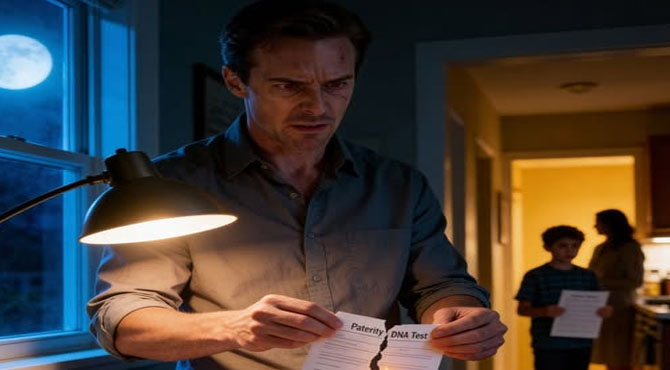
My son, Leo, turned ten last week. As he blew out the candles, surrounded by laughter and applause, I looked at his face. He has a bright, infectious smile and wild, curly hair.
He looks nothing like me.
I have straight, thin hair and pale skin. My wife, Sarah, is petite with soft features. Leo is already tall for his age, with an olive complexion and a sturdy build. For years, I ignored the differences. They say genetics are funny; they say traits can skip a generation.
But the older Leo got, the louder the whispers became.
It started with jokes from neighbors. ” The milkman must be handsome,” they’d chuckle. Then, it became the hushed gossip of relatives at family gatherings. “He doesn’t have the family nose,” my aunt would whisper. “Are you sure there wasn’t a mix-up at the hospital?”
I always defended Sarah. We have been married for twelve years. She is the most devoted, gentle, and traditional woman I know. Her life revolves around me and Leo. The idea of her cheating was impossible.
Until the doubt started to rot me from the inside.
Last month, after a stranger at the supermarket asked if Leo was my adopted son, I snapped. I couldn’t take the uncertainty anymore. Not because I didn’t love him, but because I needed to shut everyone up. I wanted proof to throw in their faces.
I took a strand of Leo’s hair from his comb and sent it to a lab.

The Result
When the envelope arrived, my hands were shaking. I sat in my car, parked a block away from our house, and tore it open. I scanned the paper for the word “Positive.”
Instead, I saw a zero.
0% probability of paternity.
The world stopped spinning. The air left the car. I read it again. And again. Not my son.
A wave of nausea hit me, followed immediately by a blinding rage. For ten years, I had been raising another man’s child? The woman who made my coffee every morning, who ironed my shirts, who held my hand during hard times—she had played me for a fool?
I drove home, gripping the steering wheel so hard my knuckles turned white. I was ready to storm in, throw the papers on the table, and demand a divorce.
But when I walked through the door, the house was quiet. I heard humming coming from the kitchen. Sarah was there, making my favorite stew. She looked tired—she had spent the last week nursing my elderly mother who was bedridden with the flu.
I watched her from the doorway. She wasn’t on her phone texting a lover. She wasn’t out partying. She was chopping carrots, looking exhausted but content.
How? I asked myself. How could this woman be a liar?
Something didn’t fit. The anger in my chest turned into a cold, heavy knot of confusion. I decided not to confront her yet. If she was this good at lying, she would only deny it. I needed to know when.
The Investigation
I went into my study and locked the door. I pulled out our old calendars and diaries. I traced back to the year Leo was conceived.
That year… I paused.
That was the year I received a massive promotion. I was sent to oversee a project in Singapore for six months. It was the biggest break of my career. I left when Sarah was three months pregnant. I remembered how sad she was to see me go, but she insisted I take the job for our future.
I returned only a week after Leo was born.
I sat back in my chair. So that was it, I thought bitterly. I was away, and she was lonely.
I began tearing through the closet where we kept old documents, looking for anything—a letter, a photo, a receipt—that would give me a name. I found an old, dusty shoebox tucked in the very back, beneath her winter coats.
Inside, there were no love letters. There was a medical file.
It was from a hospital, dated two months after I had left for Singapore.
The Truth
My hands trembled as I opened the file. It wasn’t a birth record. It was an emergency room report.
Patient: Sarah Jenkins. Diagnosis: Severe abdominal trauma due to fall. Outcome: Spontaneous abortion (Miscarriage) at 22 weeks. Uterine rupture. Emergency Hysterectomy required to save the mother’s life.
I stopped breathing.
My wife hadn’t just lost our baby. She had lost the ability to ever have children.
Beneath the medical file was another document. Legal papers. Adoption papers.
It was a private adoption of a baby boy, abandoned at birth, arranged three months later—exactly around the time she was “due.”
I sat on the floor, surrounded by old papers, and the tears came. They didn’t stop.
I remembered the phone calls during those six months. She never mentioned a fall. She never mentioned the hospital. She would complain about back pain, about the baby kicking.
She had faked the rest of the pregnancy.
She wore padding. She went through the trauma of losing a child and the physical agony of a major surgery all alone. She did it because she knew how desperate I was to be a father. She knew I was the only son in my family, and the pressure to continue the bloodline was immense. She was terrified that if I knew she could not give me a child, our marriage would crumble.
She had taken a broken, abandoned baby and claimed him as ours, shielding me from the grief she carried every single day.
The Fire
I heard the front door open. Leo was home from school.
“Mom! Dad! I got an A on my math test!” he shouted.
I wiped my face and stood up. I looked at the DNA test result on my desk. The piece of paper that proved “the truth.”
Scientific truth is cold. It deals in biology. But it doesn’t measure love. It doesn’t measure the nights Sarah stayed up with Leo when he had a fever. It doesn’t measure the pride I felt when he took his first steps into my arms.
I took the DNA test and a lighter from my drawer. I walked to the metal trash bin in the corner of the room.
I lit the corner of the paper.
I watched the “0%” turn into black ash. I watched the proof of my “betrayal” curl up and disappear.
I walked out to the living room. Sarah looked up, startled by my red eyes.
“Honey? Are you okay?” she asked, concern instantly washing over her face.
I looked at her—really looked at her. I didn’t see a liar. I saw a woman who had stitched her own heart back together in silence so that mine wouldn’t break.
I walked over and pulled her into a hug so tight it lifted her off the ground.
“I love you,” I whispered into her hair, my voice cracking. “Thank you. Thank you for everything you’ve done for us.”
She pulled back, confused, searching my eyes. “What brought this on?”
I looked over at Leo, who was showing me his test paper, waiting for a high-five. That was my boy. My son.
“Nothing,” I said, smiling through the tears. “I just realized how lucky I am to be Leo’s father.”
I will never tell her I know. I will take this secret to my grave. Because being a father isn’t about DNA. It’s about the man who stays, and the woman who loved us enough to make us a family against all odds.