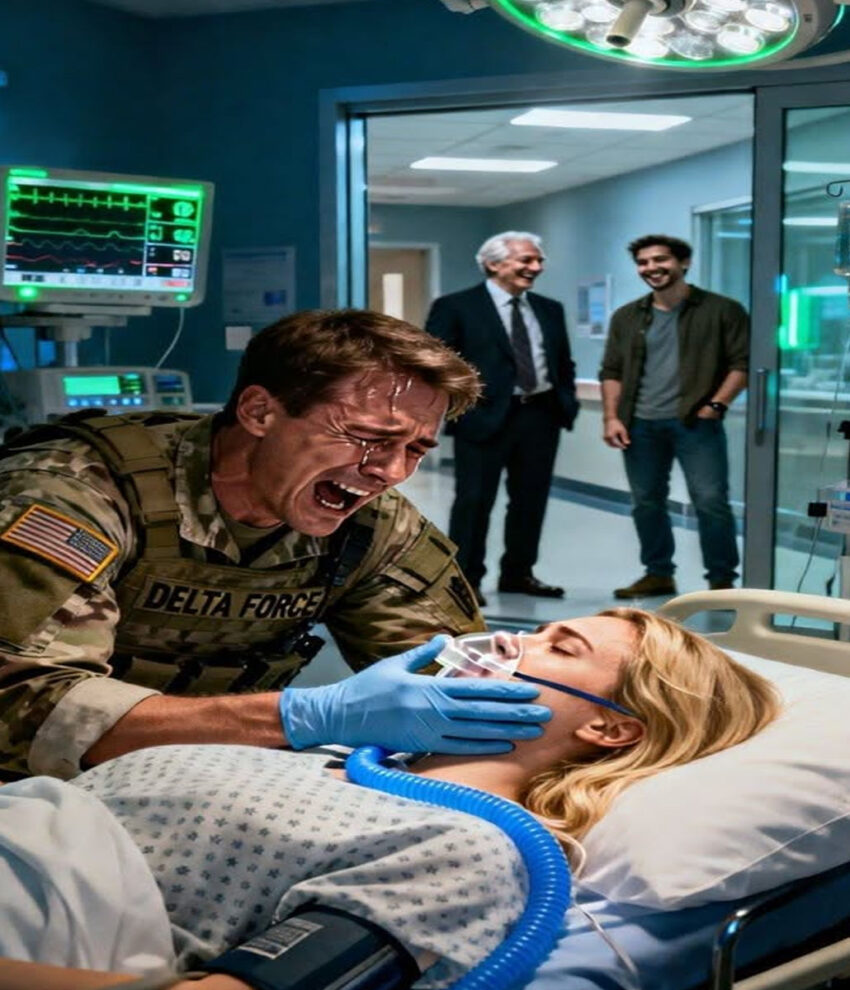
The ringing of a phone at midnight is a sound most men dread, but for a soldier, the real terror isn’t the cacophony of war. It isn’t the sharp crack of a sniper’s rifle or the concussive, chest-thumping thud of mortar fire. Those are known quantities. The true terror is the silence that greets you when you return from the shadows to a house that should have been a sanctuary, only to find it has been transformed into a tomb.
I have spent my adult life in the service of Delta Force, a shadow in the shifting sands of the desert. I have watched villages incinerated and felt the heat of IEDs as they tore through steel and bone. But nothing—absolutely nothing—prepared me for the sight of my wife, Tessa, in that ICU bed. The doctors didn’t speak of injuries; they spoke of demolition. Thirty-one fractures. Blunt force trauma. A face I had memorized by touch, the lighthouse of my sanity during six-month rotations that officially didn’t exist, had been beaten into a map of purple and black ruin. The worst part of the nightmare, however, wasn’t the carnage. It was the fact that the men who had dismantled her were standing right outside her door, wearing expensive suits and pretending to grieve.
The flight back from deployment is usually a marathon of anticipation. You vibrate with the hum of the engine, replaying the moment you walk through the door. I had imagined the heavy thud of my gear hitting the hardwood, the sound of Tessa’s socks sliding as she ran to meet me, the feeling of her leaping into my arms. That was the dream that kept me human while I hunted monsters in the dark. But when my taxi pulled up at 0200 hours, the house was a black void. Tessa never turned the porch light off when I was coming home; it was her way of guiding me through the storm.
The front door was unlocked, pushed open an inch. Instinct took over. I reached for a sidearm that wasn’t there, clearing rooms with a tactical efficiency that felt wrong in my own hallway. The house didn’t smell like home. It smelled of bleach—sharp, chemical, and suffocating. Beneath the bleach was the unmistakable, metallic tang of copper. Every operator knows that smell. It is the scent of fresh violence. In the dining room, the rug was gone, and the floor was still damp. Someone had tried to scrub away a tragedy.
A call from a Detective Miller sent me racing to St. Jude’s Medical Center. When I arrived, the nurses looked at me with a pity that served as a terminal warning. In the ICU waiting area, I found a blockade. Victor Wolf, Tessa’s father and a man who owned the county’s real estate and its politicians, sat checking his watch as if my wife’s life were a board meeting. Surrounding him were the “Wolf Pack”—Tessa’s seven brothers: Dominic, Evan, Felix, Grant, Ian, Kyle, and Mason. Arrogant, loud men who viewed the world as something to be bought or broken. They had always despised me, the “grunt” who wasn’t worthy of their princess.
Dominic, the eldest, tried to block my path to her room. I looked into his eyes with the cold clarity of a man who had seen death up close. “Touch me again, Dominic, and you’ll be in the bed next to her.” He saw the predator in my gaze and stepped back.
Tessa was unrecognizable. Her jaw was wired, her head partially shaved for railroad-track stitches, and her body was a canvas of trauma. Detective Miller claimed it was a botched robbery—a home invasion gone wrong. But I knew better. I looked at Tessa’s clean fingernails; there was no skin beneath them. A woman who took kickboxing three times a week would have fought back against a stranger. She didn’t have defensive wounds because she knew her attackers. She had let them get close.
I confronted Victor in the hall, seeing the lack of grief in his dead eyes. He looked inconvenienced, not heartbroken. I noticed Mason, the youngest brother, shaking as he held a coffee cup. I told them I would find the truth, and I would do what I was trained to do.
I returned to the house, no longer a husband, but an operator. In the dining room, I analyzed the blood splatter. It wasn’t wild or panicked; it was vertical. Controlled. Punishment, not a struggle. I found scuff marks from heavy boots—four sets. They had pinned her. Then, I remembered what Tessa had told me before I deployed: “If anything happens, check the table.”
I crawled under the heavy oak dining table and found a digital voice recorder taped to the frame. When I pressed play, the nightmare became audible. I heard Victor’s voice—arrogant and cold—demanding she sign papers to use my military name for his shell companies. I heard her refuse, her voice shaking but defiant, defending my honor. Then, I heard the command: “Grab her.” I heard the sickening thuds. I heard Victor command Mason to hold her legs and Grant to hold her arms. Thirty-one strikes with a blunt object because she wouldn’t let them drag me into their filth.
The sadness evaporated, replaced by a crystalline, predatory focus. I went to the garage, where a false wall behind my tool bench hid a heavy steel safe. I didn’t reach for a gun. A gun is mercy; a gun is quick. Victor and his sons deserved neither. I took my plate carrier, heavy-duty zip ties, and a black KA-BAR knife.
I drove to a 24-hour hardware store, moving through the aisles like a contractor. I bought plastic sheeting, a staple gun, and a heavy, claw-style framing hammer. I weighed the tool in my hand, feeling its balance. It was the same instrument they had used to break my world.
The Wolf Pack would be at The Velvet Lounge, the private club Victor owned, celebrating their “victory.” They thought they had won because Tessa was silenced and I was just a husband. They were disastrously wrong. They had forgotten that you don’t hunt a hunter. They had broken my wife, but in doing so, they had unleashed the shadow I had spent years trying to keep at bay.
I closed the safe and pulled my hoodie over my head. I knew where to start. Mason, the youngest, the weak link, the one who had held her legs while his brothers broke her bones. He was the one who would scream first. The silence of the night was about to end, and I was the one bringing the storm. I wasn’t going to call the police; I was going to be the justice the law was too bought to provide. By dawn, the Wolf Pack would realize that some things cannot be bought, and some men cannot be broken. I was coming for them, and I was bringing a hammer.