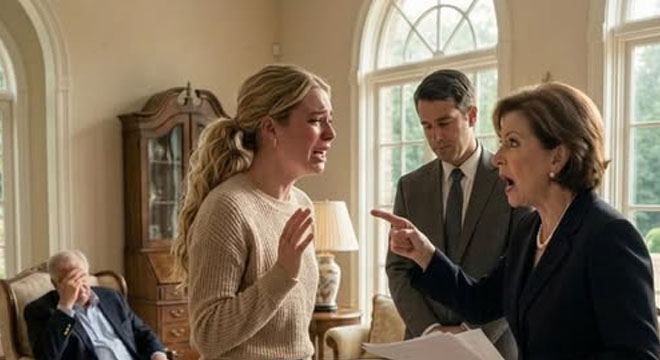
On the day I married Nolan Pierce, I told no one who I really was.
Not Nolan. Not his relatives. Not even the women fastening my veil in the bridal suite at St. Matthew’s in Pittsburgh. To everyone there, I was simply Evelyn Hart—quiet, polished, practical. A project coordinator from Erie with a modest apartment, a sensible car, and a taste for understated cashmere that only looked plain from a distance.
- On my way to my son’s house, I stopped for gas when a stranger suddenly wa:rned me, “Don’t go. You’ll regret it.”

On the way to my son’s house, I pulled into a gas station when a stranger abruptly warned me, “Don’t go. You’ll […]
- On Mother’s Day, my grown kids told me they had chosen the restaurant and expected me to pay for all twelve of them, just like always.

On Mother’s Day, my adult children informed me that they had already picked the restaurant and expected me to cover […]
That was exactly how I wanted it.
My father, Theodore Hart, had spent forty years building one of the most respected industrial supply companies in western Pennsylvania, but he never raised me to worship wealth. He raised me to study what wealth revealed in other people.
“Never hide your character,” he used to say. “But never advertise your leverage.”
So when I fell in love with Nolan—a thoughtful architect with tired green eyes, an easy laugh, and a way of listening that made the rest of the room disappear—I stayed silent. He knew my father ran a regional supply company. That was true. He just didn’t know how large it was, how many hospitals, transit hubs, and municipalities depended on it, or that within two years, my father planned to hand operational control to me.
I simply chose not to explain.
At first, that silence felt unnecessary. Nolan never pried. He never asked questions that sounded like calculations. He never acted impressed by titles, money, or family names.
His mother, however, was another matter entirely.
Claudia Pierce had perfected the kind of smile that looked warm until you listened to it too closely. At the rehearsal dinner, she clasped my hand and told me, “You’re such a sweet surprise. Nolan always needed someone simple and grounding.”
At the reception, she asked where exactly I rented, whether my “people” had come in from out of town, and whether my father intended to “do something helpful” for the newlyweds. Every question came wrapped in perfume and polished manners, but the assessment beneath them was obvious.
Nolan dismissed it with embarrassment. “She gets strange around weddings.”
I wanted to believe him.
For six weeks, marriage was soft and ordinary in all the ways that make love feel safe. We settled into Nolan’s brownstone in Sewickley. I learned he left cabinet doors open when he was distracted. He learned I checked every exterior lock twice before bed. We hosted his sister for dinner, argued over a plumber, and started building a life that felt steady enough to trust.
Then, on a gray Thursday morning, Claudia arrived without warning.
She wasn’t alone.
A man in a charcoal suit followed her into the foyer carrying a leather portfolio. He had the kind of bland, professional calm that only appears on men paid to make insult sound respectable.
Nolan came downstairs looking confused. I stood near the entry table with a mug of coffee in my hand and watched Claudia remove her gloves with deliberate grace.
“I’m sorry for the drama,” she said, sounding nothing like she meant it. “But this is a matter of family protection.”
The attorney opened his portfolio and placed a packet of documents on the table as if he were setting down something neutral.
Claudia lifted her chin toward me.
“Before this marriage goes any further,” she said, “my son needs a postnuptial agreement. I’ve seen women with no real background attach themselves to men with potential before. These papers will ensure no one takes what belongs to the Pierce family.”
Nolan stared at her as though he had stopped understanding the language she was speaking.
I looked at the packet.
Then I looked at her.
And in that moment, I was deeply grateful I had told her nothing.
Because those papers, like her assumptions, meant absolutely nothing.
The silence that followed had weight.
Nolan moved first. “Mother, what is this?”
“Prudence,” Claudia replied coolly. “Something you’ve always lacked.”
Her attorney, Gregory Sloat, cleared his throat and nudged the papers slightly forward. “This is a standard postnuptial framework intended to protect existing and future family interests. It’s best to address these matters early, before misunderstandings become expensive.”
I nearly laughed.
Not because it was funny, but because the performance was so transparent. “Family interests” in this case meant Nolan’s brownstone, a design practice with uneven income, and whatever illusion of inherited importance Claudia had built around them. She looked at me as if I were a woman in practical heels trying to secure a fortune.
Nolan pushed the documents away. “You brought a lawyer into my house to accuse my wife of marrying me for money?”
Claudia’s expression sharpened. “I brought a lawyer because emotions make men foolish.”
I should have been furious. I was. But beneath the anger, there was relief too. If she had hidden herself for longer—if she had stayed gracious for a year or two before showing her hand—the betrayal might have cut deeper. Instead, she exposed herself early, before my life was more tangled with hers.
“I think you should leave,” Nolan said.
Gregory spoke before she could. “Mr. Pierce, with respect, if your wife has nothing to gain, she should have no problem signing.”
I set my mug down beside his folder and looked directly at him. “Mr. Sloat, are you licensed in Pennsylvania?”
He blinked. “Yes.”
“Then you should know better than to frame coercive timing as harmless administration. You arrived unannounced at a private residence carrying a legal instrument designed to pressure one party into surrendering rights she hasn’t even tried to assert. This isn’t prudence. It’s theater.”
Claudia’s face changed then—only slightly, but enough.
Enough to show she hadn’t expected precision from the “simple” girl.
Nolan turned toward me, still angry but now confused as well. “Evelyn, you don’t have to explain anything. I’m not signing anything, and neither are you.”
I touched his arm. “I know.”
The truth was that before the wedding, on my father’s advice, I had already signed a detailed asset-protection structure covering family holdings, trust arrangements, succession rights, and my future control of Hart Industrial Systems. Not because I feared Nolan, but because family businesses survive on legal architecture, not sentiment. Hart Industrial Systems was not the kind of thing anyone could simply take in a divorce. It was protected by trusts, boards, and voting structures stronger than Claudia’s imagination.
But I didn’t say any of that.
Not yet.
Instead, I asked Gregory, “Did you draft this agreement based on full financial disclosure from both parties?”
He hesitated just long enough to answer the question for me. “We prepared it based on the assets disclosed to us as currently relevant.”
Meaning: based on what Claudia believed Nolan had, and what she assumed I didn’t.
I nodded once. “Then it’s worthless.”
Claudia gave a brittle little laugh. “How convenient.”
“No,” I said. “How legal. An agreement built on incomplete assumptions and introduced under pressure six weeks into a marriage is not the weapon you think it is.”
Nolan opened the front door. “Leave. Now.”
Claudia stood perfectly straight, gloves clenched in one hand. “You’re making a mistake over a woman you barely know.”
Nolan’s voice dropped, cold and controlled. “No. The mistake was thinking you could humiliate my wife in our home and still call it concern.”
She left without another word.
Gregory followed, gathering his folder with irritation.
The door closed.
And the house became very quiet.
Nolan turned to me with questions in his face—not suspicion, not greed, just confusion. He had just watched his mother accuse me of being a fortune hunter and watched me dismantle her attorney like I’d done it before.
“I owe you an explanation,” I said.
He studied me for a moment, then shook his head. “Only if you want to give one.”
That was the moment I loved him more than I had that morning.
So I told him everything.
I told him about my father founding Hart Industrial Systems in 1986 out of a rented warehouse with one forklift and three clients. I told him about my mother running payroll at the kitchen table while I drew on the backs of invoices. I told him the company now employed more than six hundred people and supplied critical infrastructure across five states. I told him I hadn’t been raised to inherit a title but to earn competence. Procurement. Operations. Labor relations. Compliance. My father believed inheritance without discipline was just decay in polished packaging.
Nolan sat down halfway through my explanation like his body needed the chair to absorb it.
When I finished, he exhaled slowly. “You really thought I’d care?”
“I thought your mother would,” I said.
A humorless laugh escaped him. “That, apparently, was the safest bet in Pennsylvania.”
Then his face softened. “Why didn’t you tell me?”
“Because I needed to know who loved me before they knew what came with me.”
He took my hand. “And now?”
“Now I need to know whether this changes anything.”
He squeezed my fingers gently. “Only this. Next time my mother brings a lawyer into my house, I’d like five minutes’ warning before discovering my wife is better prepared than the rest of us.”
I laughed despite myself.
But I knew Claudia too well to think it was over.
Women like her don’t retreat after humiliation. They regroup.
And eight days later, she proved me right.
Her second attempt came wrapped in civility.
She invited me to lunch at the Duquesne Club, texting that she wanted to “clear up unfortunate misunderstandings.” Nolan wanted to refuse on my behalf, but I told him I would go.
Not alone—my father’s general counsel, Miriam Kessler, remained nearby in case the lunch turned strategic—but I went.
Claudia was already seated, immaculate in ivory silk, smiling as though we were there to gently untangle a social misunderstanding instead of discuss an ambush.
“Evelyn,” she said warmly, “thank you for coming. I think we got off on the wrong foot.”
“We got off on legal threats in my foyer,” I said. “That was more than a foot.”
Her smile barely flickered.
For ten minutes, she performed apology with exquisite control. Old